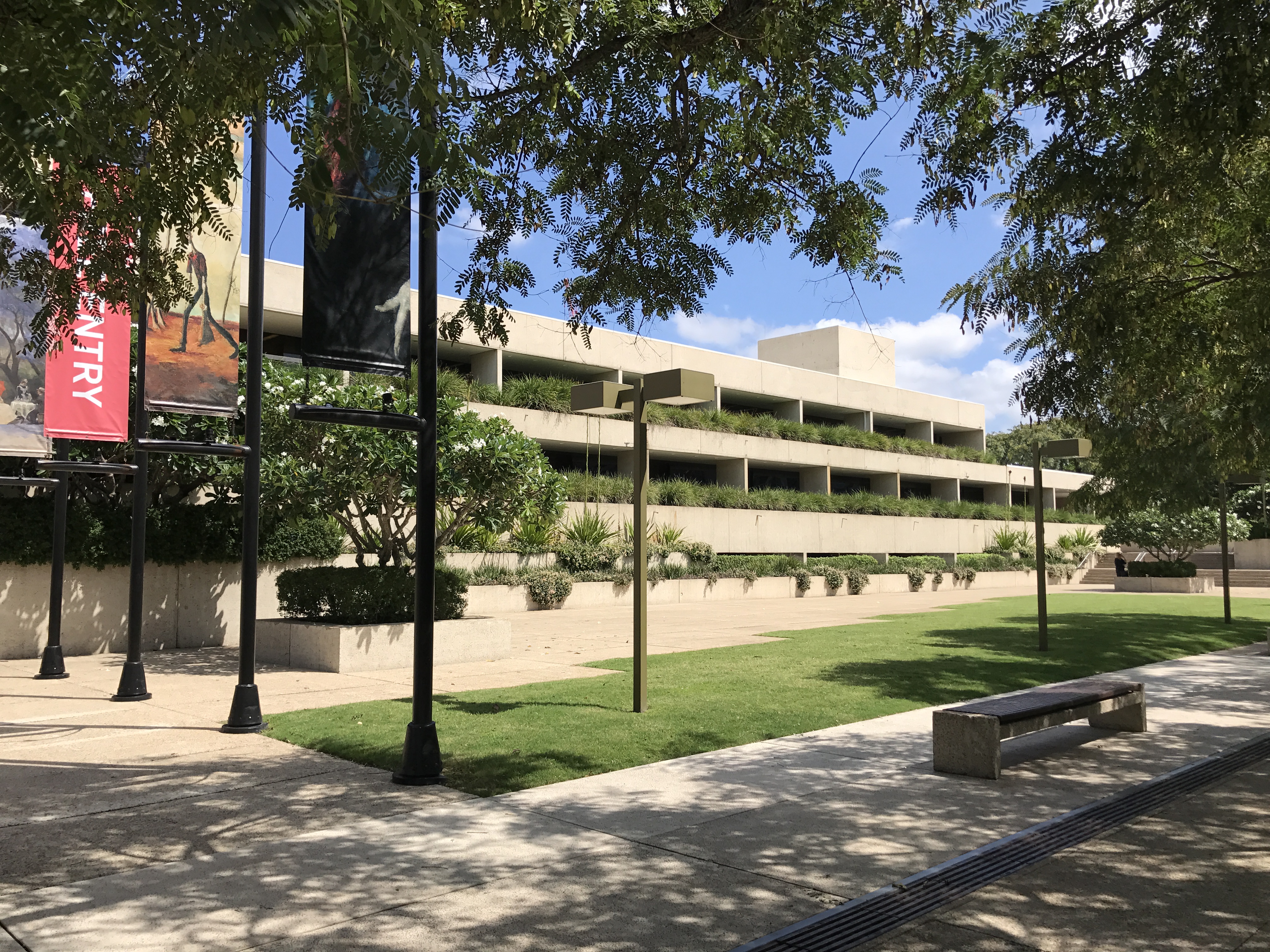
For thirty-two years, the Asia Pacific Triennial has been QAGOMA's continuing argument that the regional contemporary art conversation is the work of a host institution's curatorial team, not of a rotating international guest curator. The institutional model the field calls the APT model is the structural inheritance of a single Brisbane museum.
The Asia Pacific Triennial of Contemporary Art opened in September 1993 in Brisbane, at the Queensland Art Gallery, under the directorship of Doug Hall, the Australian museum director who led the Queensland Art Gallery from 1987 to 2007 and who is, in the institutional record, the architect of the APT's founding institutional argument. The premise the founding edition took was, in 1993, a thesis: that the contemporary art conversation of the Asia-Pacific region was not yet sufficiently registered in the institutional collections, exhibitions, and curatorial vocabulary of the Western international biennial circuit, and that a Brisbane-based museum could programme that conversation seriously, at sustained institutional weight, across decades. By the third edition (1999), and clearly by the fourth (2002), the thesis had become the institutional fact. The APT has, more than any other museum programme of the period, established that contemporary art from across the region (the South Pacific island nations, Southeast Asia, East Asia, the Indian subcontinent, the Pacific Rim) could be programmed as a continuing curatorial argument rather than as an occasional thematic intervention.
The 11th edition opened on 30 November 2024 and closed on 27 April 2025, with more than 500 works by approximately 70 artists and collectives across the QAG and GOMA buildings. The exhibition was developed by an in-house curatorial team led by Tarun Nagesh, the institution's Curatorial Manager for Asian and Pacific Art, with Abigail Bernal, Ruha Fifita, Ruth McDougall, and Reuben Keehan: QAGOMA curators across the institution's Asian, Pacific, and contemporary art programmes, each with sustained regional research practice that long predates the specific commissioning cycle of any one APT edition. That continuity is what the institutional model the APT runs on actually consists of. The triennial does not invite an external Artistic Director; it does not start a new curatorial conversation every three years; it does not, in the European biennial sense, exist as a guest-curator event at all. It is the public-facing expression of a continuing year-round QAGOMA curatorial programme that begins, in practical institutional terms, the day the previous edition closes.
The in-house model, against the field
That structural choice has been the Asia Pacific Triennial's most-distinguishing institutional feature. Every other major international biennial of the post-1990 period (Venice, documenta, the Whitney, Sydney, São Paulo, Gwangju, Sharjah, Manifesta, Berlin) has organised itself around a rotating Artistic Director (or curatorial team) commissioned anew for each edition. The Asia Pacific Triennial has instead stayed inside the institution that hosts it, and let the institutional accumulation of regional curatorial knowledge (the collection-building, the long working relationships with artists across multiple editions, the slow institutional understanding of how a region's contemporary practice changes over decades) do the work that, elsewhere, the rotating-curator model is meant to do. The QAGOMA collection of contemporary Asian and Pacific art is, by international art-museum consensus, among the most consequential institutional collections of the region's contemporary art anywhere in the world; the depth of relationships across Pacific artist communities is unrivalled in the Western institutional record.
The advantages of the model have been clear. The disadvantages are equally clear: an in-house curatorial team cannot be easily refreshed by an outside curatorial perspective, and the institution's curatorial position, however carefully developed, is the curatorial position the exhibition consistently expresses. Whether the model can continue to register the emerging conditions of the regional contemporary art conversation, or whether the Triennial will eventually have to accept a structural change in its commissioning model, is the principal continuing institutional question. The QAGOMA position, defended consistently across the directorships of Doug Hall (1987–2007), Tony Ellwood (2007–2012), and Chris Saines (from April 2013), has been that the in-house model is the position the institution argues for and is not negotiable. APT11 was the eleventh institutional demonstration of that argument.
The 11th, the institutional model thirty years in
APT11 was the longest-running edition in the institution's history at 149 days, and the most widely-distributed across the region in terms of participating-artist origin. Pacific commissioning, under Ruth McDougall and Ruha Fifita, extended into Tongan, Samoan, Solomon Islander, Papuan, and Aboriginal Australian artist communities; East and Southeast Asian commissioning, under Reuben Keehan, included substantial work from Vietnam, Indonesia, the Philippines, Korea, and Japan; the South Asian programme, under Tarun Nagesh and Abigail Bernal, extended the institution's continuing relationship with contemporary Indian, Bangladeshi, and Pakistani practice. The exhibition's principal institutional achievement, by the consensus of the international art press, was the demonstration that the QAGOMA model continues to produce regional curatorial argument at scale: that, at thirty-two years, the institution remains the most institutionally consequential continuing demonstration that a major regional biennial can be programmed without a rotating external Artistic Director.