The Thai contemporary art biennial founded 2018 by Apinan Poshyananda: privately funded through ThaiBev, structurally built on Bangkok's major Buddhist temples as commission sites, and operating under the specific political conditions of post-junta Thailand.
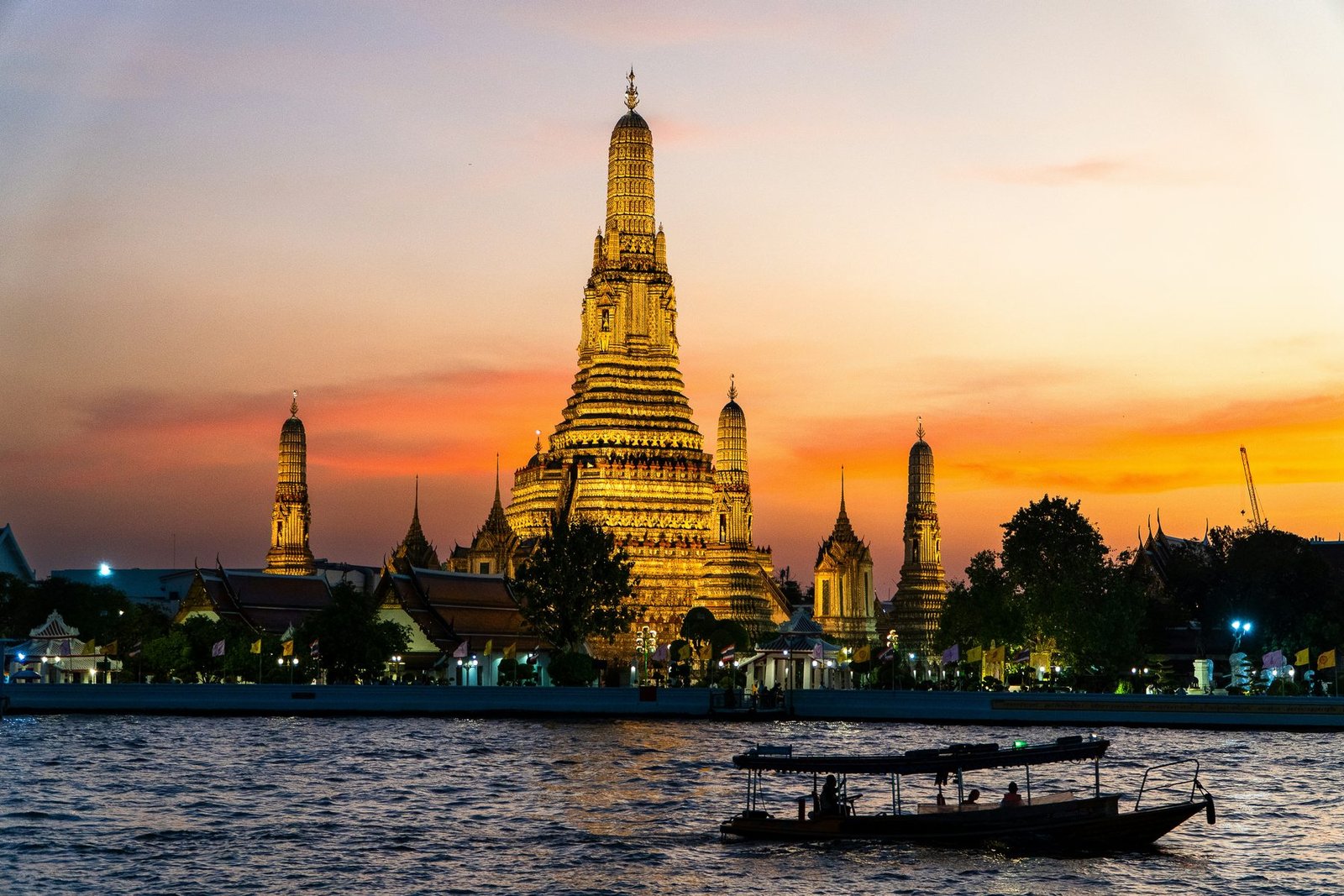
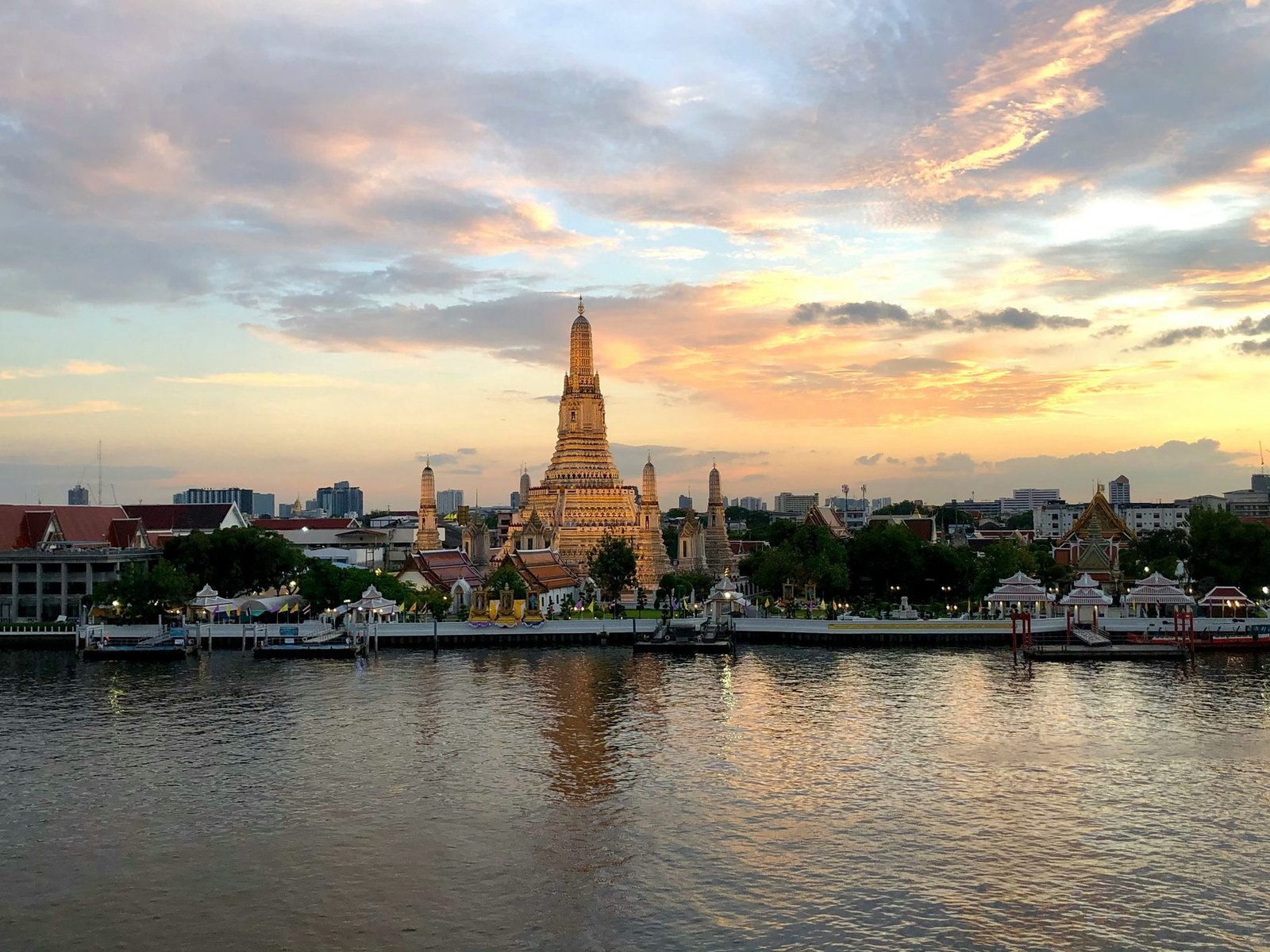
Above Wat Arun, the Temple of Dawn on the Chao Phraya River in Bangkok, one of the Buddhist temple sites the Bangkok Art Biennale has consistently used as a principal commission venue since 2018. The temple-venue model is the biennial's most institutionally distinctive curatorial premise. · Photograph: Wikimedia Commons
Next edition announced
The 5th Bangkok Art Biennale, Angels and Mara, opens on October 29, 2026 and runs to February 28, 2027 across 10 venues including Wat Arun, Wat Pho and BACC.
When the 1st Bangkok Art Biennale opened in October 2018, it was the first major international contemporary art biennial in the world to take its host city's principal Buddhist temples (Wat Pho, Wat Arun, Wat Prayoon) as commissioning venues rather than as scenic backdrop.
By the Biennale Editorial Team
The Bangkok Art Biennale (BAB) was founded in 2018 by Apinan Poshyananda, one of the most internationally visible curators of Southeast Asian contemporary art, with private funding from Thai Beverage Public Company (ThaiBev), the Charoen Sirivadhanabhakdi family's Thai beverage and real-estate conglomerate, one of the largest privately-held businesses in Southeast Asia. The institutional architecture is structurally distinct from most of the major contemporary biennials: BAB is not a state biennial, it is not a municipally-funded biennial, it is not anchored at a major public museum. It is a privately-funded biennial operating through a non-profit foundation (the Bangkok Art Biennale Foundation) under the sustained patronage of a single corporate philanthropic source. The institutional case for the model (that Thailand, the largest contemporary art market in mainland Southeast Asia, deserved a international biennial and that the state cultural infrastructure was not in a position to produce one) has held across four editions.
The curatorial premise of BAB has been the temple-venue model. The 1st BAB (19 October 2018 – 3 February 2019), Beyond Bliss, used Wat Pho (the Temple of the Reclining Buddha), Wat Arun (the Temple of Dawn), and Wat Prayoon as principal commission sites alongside the Bangkok Art and Culture Centre (BACC) and a network of partner venues. The premise was substantive: Bangkok's major Buddhist temples are not historical monuments visited primarily by tourists but continuing religious sites with continuing communities of practice, and contemporary art commissioned to be sited in them must engage their continuing religious and cultural life rather than treating them as scenic backdrop. The 1st BAB included Marina Abramović, Yoshitomo Nara, Choi Jeong Hwa, Aurèle, and a body of Thai contemporary artists working with the temple-venue conceit. The premise has held across subsequent editions: the 2nd BAB (Escape Routes, 29 October 2020 – 31 January 2021), the 3rd BAB (Chaos : Calm, 22 October 2022 – 23 February 2023), and the 4th BAB (Nurture Gaia, 24 October 2024 – 25 February 2025) have all programmed at Wat Pho, Wat Arun, and Wat Prayoon alongside the continuing partner venues at BACC, ICONSIAM (the ThaiBev-Group-funded riverside cultural-and-commercial complex that opened 2018 and anchors the biennial's commercial-cultural footprint), the One Bangkok complex, and the Museum Siam.
The curatorial work of the temple-venue premise has produced one of the more interesting institutional answers to a question the international biennial conversation has debated across the post-2000 period: what is the curatorial work of a major international biennial in a city outside the European-and-North American axis whose cultural infrastructure predates the biennial form? Bangkok's cultural infrastructure, the temples themselves as continuing religious institutions, the Bangkok contemporary art scene whose institutional anchors predate BAB (BACC opened 2008; the Jim Thompson Art Center; the network of private galleries; the generation of Thai contemporary artists including Rirkrit Tiravanija, Navin Rawanchaikul, Manit Sriwanichpoom, Sutee Kunavichayanont, and the younger generation around Pratchaya Phinthong and Korakrit Arunanondchai), exceeds what the biennial as a once-every-two-years institutional intervention can produce or substitute for. BAB's curatorial response has been to defer to the temples as continuing institutional partners and to programme alongside rather than over the existing Bangkok contemporary art infrastructure.
The political conditions under which BAB has operated are substantive. The biennial was founded in 2018, four years after the May 2014 Thai military coup d'état that brought the junta of General Prayut Chan-o-cha to power, and during the post-coup period of military-led civilian government, the disputed 2019 elections, and the continuing post-2020 democracy-movement protests that have shaped Thai political life across BAB's institutional history. The biennial has operated as a privately-funded cultural institution with royal-and-state patronage relationships: the temples themselves are administered under the Royal Thai religious-administrative architecture, ThaiBev's continuing institutional relationships extend into Thai royal and state networks, and BAB's continuing institutional position cannot be read independently of these patronage relationships. The Thai independent contemporary art scene (organised around younger-generation artists and curators whose practice has engaged the post-2014 political conditions) has engaged BAB across a range of institutional positions, from continuing participation through public critique.
The 4th BAB, Nurture Gaia (24 October 2024 – 25 February 2025), was the largest and most internationally-programmed of the four editions to date, with work by Asian, European, and North American contemporary artists alongside a continuing Thai contemporary art programme. The biennial's continuing institutional argument (that a privately-funded biennial in a major Southeast Asian cultural capital can extend the international biennial conversation into the curatorial questions of the region) has been persuasive within the international art press, and the international visibility of BAB exceeds what its institutional age would predict. The 5th Bangkok Art Biennale, Angels and Mara, runs from October 29, 2026 to February 28, 2027.
Wat Arun at sunset with a long-tail boat on the river, Bangkok. Photo: Vasant Jain.
The institutional architecture
The Bangkok Art Biennale is organised by the Bangkok Art Biennale Foundation, a Thai non-profit cultural foundation established 2017–2018 specifically to produce the biennial, with continuing institutional support from ThaiBev and the Charoen Sirivadhanabhakdi family philanthropy, the Tourism Authority of Thailand, the Bangkok Metropolitan Administration, and the continuing partnership of the Sangha Supreme Council (the governing body of Thai Buddhist monastic life) which licenses the temple-venue commissions. The Foundation's continuing structural reliance on a single principal corporate funder is the institutional question on which any reading of BAB's continuing future turns.
A Second Reading The private-funding question
When the biennial is one family's institutional project
The Bangkok Art Biennale's reliance on a single principal corporate funder (ThaiBev, controlled by the Charoen Sirivadhanabhakdi family, one of the wealthiest business families in Southeast Asia) is the institutional structural fact on which any reading of the biennial turns. The question the structure raises is not a question about ThaiBev or the Charoen family specifically; it is the structural question raised by the privately-funded-biennial model wherever it operates.
The structural question is this: when a biennial is dependent on a single principal corporate or family funder, the curatorial-institutional work of the biennial is structurally constrained by what the principal funder will and will not continue to support. This is not the same as the curatorial work being directed or censored by the funder: privately-funded biennials, including BAB, produce curatorial programmes that the principal funder may or may not have interest in, and private-funder-led biennials internationally have produced critically-acclaimed editions of curatorial autonomy. The structural question is about what is institutionally available to be programmed: a corporate-funded biennial in a state with royal-and-state patronage networks cannot programme curatorial work that would meaningfully threaten the principal funder's royal-and-state patronage relationships, because the institutional consequences for the biennial would be material. What is not programmed at a privately-funded biennial is structurally as important as what is, and the analysis of any privately-funded biennial has to account for both.
This is a structural point that applies to many of the privately-funded biennials in the contemporary international form: to BAB, to Sharjah's Foundation-supported model, to Saadiyat Island, to the Liu Bolin–era Yinchuan Biennale, to RIBOCA in Riga, to the post-2000 generation of privately-philanthropically-funded biennials in cities without state cultural infrastructure. The critical literature on this point has developed across the post-2010 period, and the international biennial conversation has incorporated it into the contemporary reading of the biennial form.
What the structural reading does not displace is the curatorial and institutional work BAB has done across four editions. The temple-venue premise is a interesting curatorial proposition; the 1st through 4th BAB programmes have extended the international biennial conversation into Bangkok; the Thai contemporary art generation BAB has platformed has benefited from the institutional infrastructure the biennial has produced. The two readings (BAB as contemporary curatorial-institutional project; BAB as structurally constrained by its private-funding architecture) are both true, and any reading of the biennial has to hold both.
In Bangkok
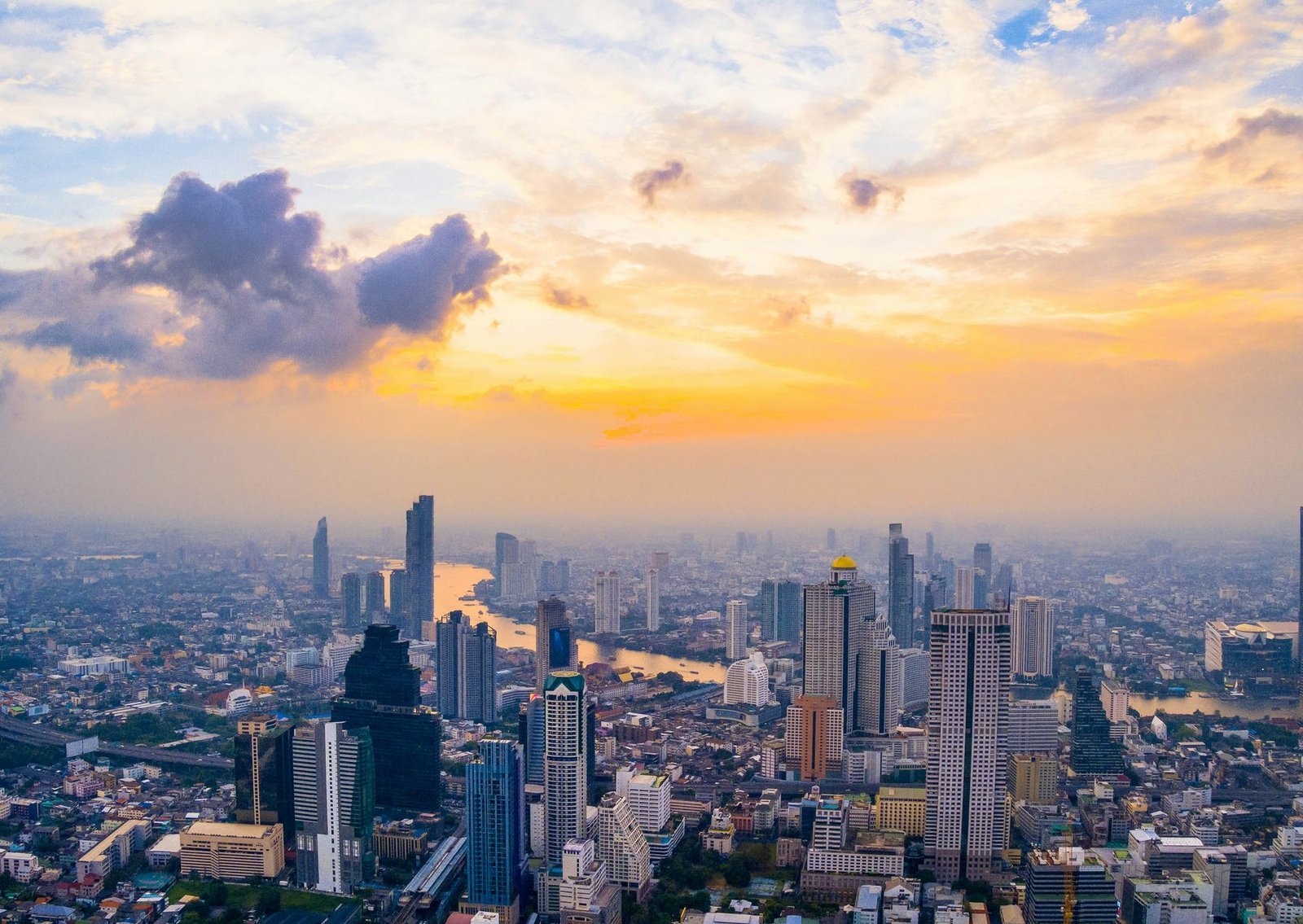
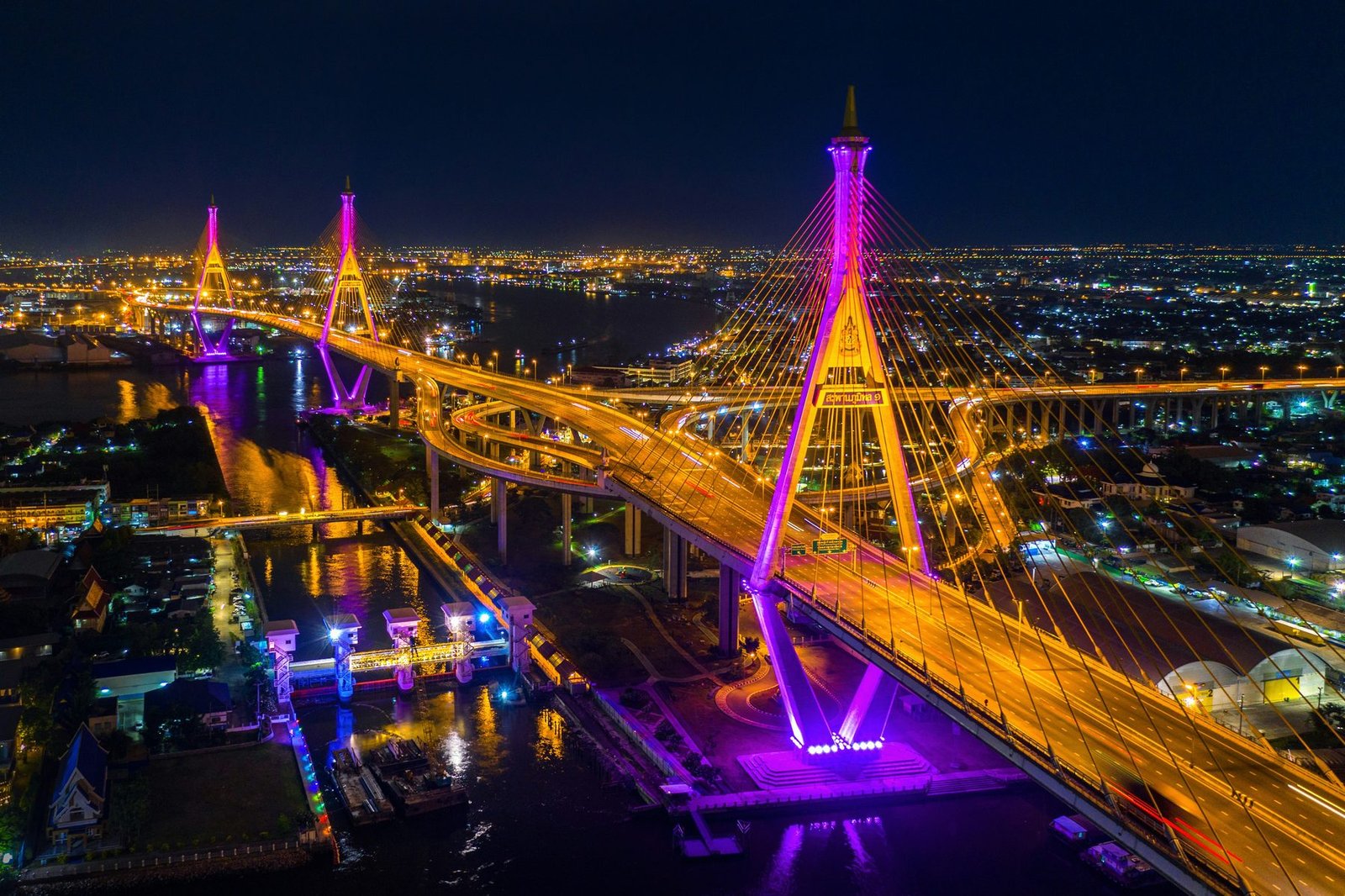
The city and the Chao Phraya River at sunset from the air, Bangkok. Photo: Waranont Joe.
Wat Arun across the Chao Phraya River at sunset, Bangkok. Photo: Bradley Prentice.
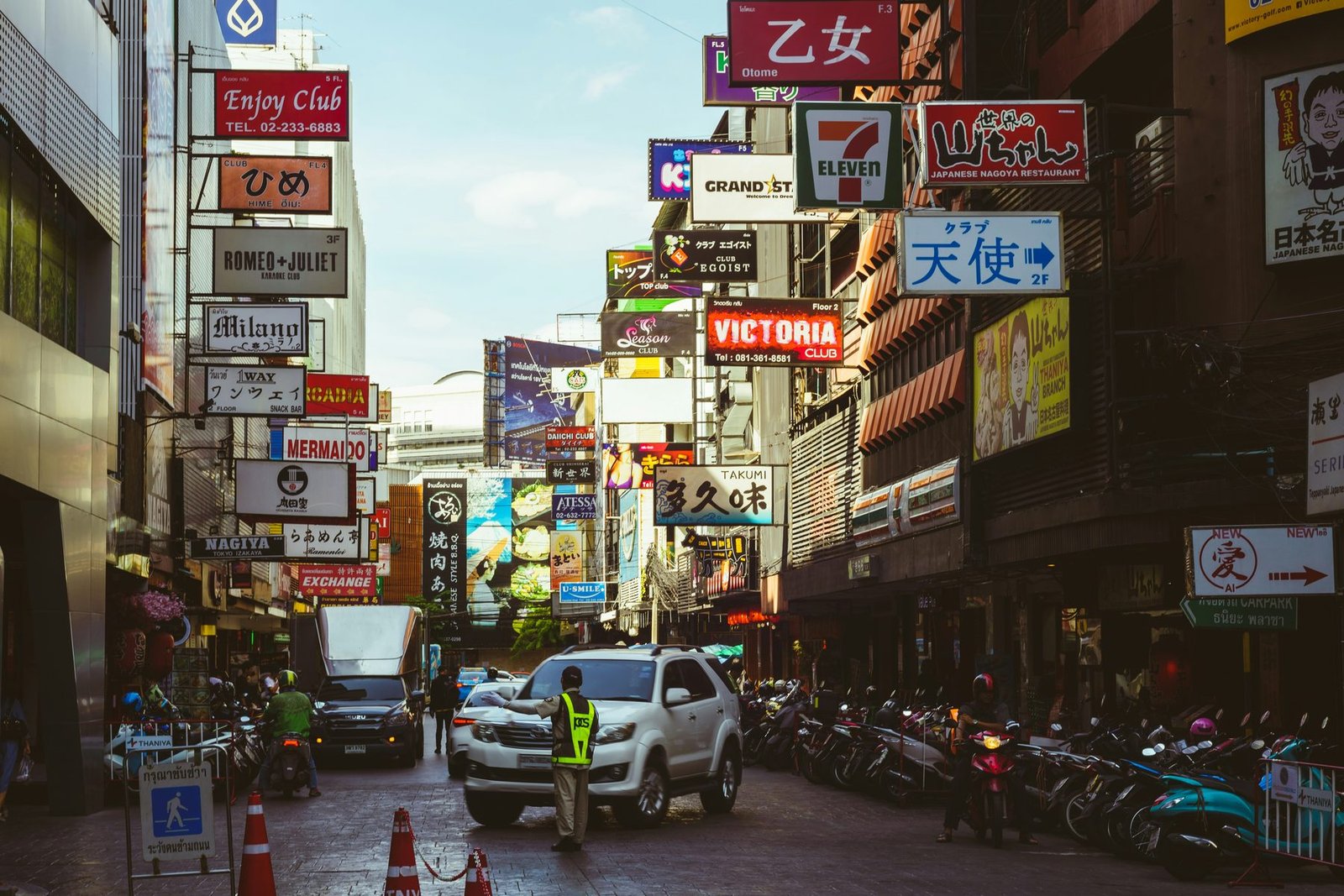
Signboards over a side street, Bangkok. Photo: Red Shuheart.
The Institutional Spine
Defining moments
Five episodes across six years.
2017–2018Founding
The Foundation, the Sangha licensing, and the temple-venue premise
The institutional architecture of the Bangkok Art Biennale was assembled across 2017–2018: the Bangkok Art Biennale Foundation was established as a Thai non-profit cultural foundation specifically to organise the biennial, with ThaiBev confirmed as principal corporate funder, and the partnership with the Sangha Supreme Council, the governing body of Thai Buddhist monastic life, was put in place to license commissions at Wat Pho, Wat Arun, and Wat Prayoon. This Sangha-licensed temple-venue partnership is the structural precondition without which BAB's founding curatorial premise could not have operated, and it has continued to anchor the biennial across all four editions to date.
Sources: Bangkok Art Biennale Foundation institutional records; bkkartbiennale.com
Oct 20181st BAB
Poshyananda's founding edition: Beyond Bliss
The 1st Bangkok Art Biennale (19 October 2018 – 3 February 2019), Beyond Bliss, opened under Chief Executive and Artistic Director Apinan Poshyananda with approximately 75 artists from 34 countries across 20 venues. The edition established the biennial's founding curatorial premise, Bangkok's major Buddhist temples (Wat Pho, Wat Arun, Wat Prayoon) as commission sites alongside BACC and partner venues, and included Marina Abramović, Yoshitomo Nara, Choi Jeong Hwa, and a body of Thai contemporary artists.
Sources: BAB 2018 archive; Artforum, Frieze, Hyperallergic coverage
Oct 20202nd BAB
The pandemic edition: Escape Routes
The 2nd Bangkok Art Biennale (29 October 2020 – 31 January 2021), Escape Routes, opened under the conditions of the continuing Covid-19 pandemic and the post-2020 Thai democracy-movement protests. The edition continued the temple-venue model under the restrictions of the pandemic period, and the title's double-reading (the pandemic and the political conditions) was legible in the curatorial work.
Sources: BAB 2020 archive; The Art Newspaper, Bangkok Post coverage
Oct 20223rd BAB
Chaos : Calm
The 3rd Bangkok Art Biennale (22 October 2022 – 23 February 2023), Chaos : Calm, was the largest of the first three editions, with approximately 73 artists across 12 venues, an extended international programme alongside the continuing temple-venue commissions. The 3rd edition consolidated BAB's reading by the international art press as a major Southeast Asian biennial.
Sources: BAB 2022 archive; international press coverage
Oct 20244th BAB
Nurture Gaia
The 4th Bangkok Art Biennale (24 October 2024 – 25 February 2025), Nurture Gaia, was the largest and most internationally-programmed of the four editions to date (approximately 65 artists across 10 venues), with commissioning across Bangkok's continuing temple sites, BACC, the One Bangkok complex, Museum Siam, and the ICONSIAM riverside cultural complex.
Sources: BAB 2024 archive; 4th edition programme
People in the Biennial
The figures behind BAB
Founder · Chief Executive and Artistic Director
Apinan Poshyananda
Thai curator, writer, and arts administrator (b. 1956). One of the most internationally visible curators of Southeast Asian contemporary art. PhD Cornell. Former Director of the Office of Contemporary Art and Culture (OCAC), Ministry of Culture, Thailand (2005–2014): the institutional architect of the Thai state contemporary art apparatus at the OCAC. Curator of the Thai Pavilion at the Venice Biennale across multiple editions. Founding Chief Executive and Artistic Director of the Bangkok Art Biennale (2018–), leading all four editions to date.
The Charoen Sirivadhanabhakdi family: controlling shareholder of Thai Beverage Public Company Ltd (ThaiBev), one of the largest beverage producers in Southeast Asia, and of the real-estate and hospitality businesses including the ICONSIAM, One Bangkok, and Asiatique developments. Significant continuing philanthropic patronage of Thai contemporary art and culture, including the principal funding of the Bangkok Art Biennale Foundation since 2018. The Charoen family is consistently among Thailand's wealthiest, and ThaiBev's continuing patronage of BAB is the structural fact on which the biennial's institutional architecture depends.
The generation of internationally-visible Thai contemporary artists whose practice predates BAB and whose continuing institutional position exceeds the biennial form. Rirkrit Tiravanija (b. 1961): relational-aesthetics pioneer, international exhibition history. Navin Rawanchaikul (b. 1971): conceptual and community-engaged practice. Pinaree Sanpitak (b. 1961): sculpture and performance practice on the female body in Thai cultural traditions. Korakrit Arunanondchai (b. 1986): international exhibition history including the 14th Sharjah Biennial.
Three of Bangkok's most institutionally significant Buddhist temples, Wat Pho (Temple of the Reclining Buddha, founded 16th century), Wat Arun (Temple of Dawn, founded 17th century), and Wat Prayoon (founded 1828), administered under the Royal Thai religious-administrative architecture and licensed to BAB as continuing commission venues across all four editions. The institutional partnership with the Sangha Supreme Council and the individual temple abbots is the institutional fact on which the temple-venue curatorial premise depends.
Bangkok's principal contemporary art institution, opened 2008. Significant continuing partner of the Bangkok Art Biennale across all four editions, with programming at the BACC's central-Bangkok exhibition halls. Operated by the Bangkok Art and Culture Centre Foundation under the Bangkok Metropolitan Administration. The BACC funding crisis of 2019–2020, when the BMA withdrew the BACC's continuing operating subsidy, was a institutional moment in the post-2010 Bangkok contemporary art conversation.
Thai non-profit cultural foundation established 2017–2018 specifically to organise the Bangkok Art Biennale, with continuing institutional support from ThaiBev and the Charoen Sirivadhanabhakdi family philanthropy, the Tourism Authority of Thailand, the Bangkok Metropolitan Administration, and the continuing partnership of the Sangha Supreme Council. Continuing institutional responsibility for the biennial across all four editions and the 5th, Angels and Mara (October 29, 2026 to February 28, 2027).
Save this biennale to your circuit, follow its artists as their pages grow, and sync every opening and closing to your own calendar on the companion app.
Modern Art in Thailand: Nineteenth and Twentieth Centuries
Apinan Poshyananda · 1992 · Oxford University Press
Reference
Biennials and Beyond 1962–2002
Bruce Altshuler · Phaidon
Theory
The Biennale Reader
Filipovic · van Hal · Øvstebø, eds.
Images, attribution & rights
Photographs are reproduced from Wikimedia Commons under the Creative Commons licences stated in each caption. If you are the photographer of an image used here and wish to discuss its use, please write to contact@biennalemail.com.
Editorial content is original and credited to the Biennale Editorial Team. The post-2010 critical literature on the privately-funded biennial form referenced in the second-voice reading is documented in the international art-press and academic-art literature of the period.