CAB is unusual among the world's principal architecture biennials in being a city-policy instrument: founded by the City of Chicago and Mayor Rahm Emanuel's office in 2015, programmed in a city that holds particular weight in the discipline's own institutional memory.
The Chicago Architecture Biennial was launched in 2015 as a public initiative of the City of Chicago under Mayor Rahm Emanuel's cultural-affairs office, sited at the Chicago Cultural Center and made free of admission as a matter of municipal policy. Where Venice's architecture exhibition descends from a state-cultural foundation with nearly a century and a half of inheritance, CAB was conceived as a contemporary civic instrument, funded substantially through municipal and philanthropic sources, programmed in coordination with the City's Department of Cultural Affairs and Special Events, and positioned as a public-facing argument that Chicago's role in the world of architecture was a continuing rather than archival one.
That structural condition shapes what the biennial can say. Across six editions the curatorial team has changed, but the venue and the civic frame have not: every edition has opened at the Cultural Center, in a city whose architectural inheritance (the Chicago School and the rebuilding after the 1871 fire; Louis Sullivan and the steel-frame office building; Frank Lloyd Wright and the Prairie idiom; Mies van der Rohe at IIT and SOM's postwar global practice) is itself part of the institutional weight any curator must work against or with. The Cultural Center is the building the biennial inhabits; the discipline's hometown is the wider site it programmes inside.
The curatorial line through the editions has been to keep widening the question of who counts as a participant in that conversation. Joseph Grima and Sarah Herda's 2015 founding edition put a broad international survey of practice on the floor; Sharon Johnston and Mark Lee's 2017 edition turned to history as material; Yesomi Umolu's 2019 edition reframed the discipline through questions of sovereignty, land, and erasure; David Brown's 2021 edition redirected attention to Chicago's own ten thousand city-owned vacant lots; the Floating Museum's 2023 edition treated the biennial as a public rehearsal rather than a finished exhibition. Each shift has been a curatorial argument about what a municipal architecture biennial is for.
Florencia Rodriguez's tenth-anniversary edition reads against that record. The 2025 SHIFT framing argues that the discipline's existing institutional vocabulary has not registered the climate, demographic, political, and economic transformations now reshaping practice, a claim that lands with particular force in the city whose nineteenth- and twentieth-century building cultures wrote much of that vocabulary in the first place. The continuing fact about CAB is that it is still doing this from a single free-admission venue in a single American city, on a roughly two-year cadence, under municipal cultural authority. That is the structural condition the editions are made under.
The tenth-anniversary moment has also coincided with a structural turnover of the institution's own leadership. In February 2025 the biennial appointed Jennifer Armetta as Executive Director. She is a Chicago gallerist and arts administrator who had built her first gallery in the city in 1996 and spent three decades supporting artists in the city's commercial-and-civic ecosystem. The board co-chairs as of CAB 6 are Nora Daley (chair of the Illinois Arts Council, and a figure widely identified with the city's contemporary arts patronage) and Sarah Herda, the same Sarah Herda who, as Director of the Graham Foundation, co-curated the founding 2015 edition with Joseph Grima and who now returns to the institutional record in a governing rather than curatorial role. The editorial and executive layer leading the tenth-anniversary edition is, for the first time in the institution's history, entirely composed of women. Read as institutional argument rather than personnel, that is a deliberate marker of where the biennial places itself a decade in.
The Chicago Architecture Biennial's first decade has also drawn external argument about what the institution should be doing in the city it is named for. Critical commentary across the editions (in Newcity, The Architect's Newspaper, and the Chicago daily press) has returned repeatedly to a tension structurally present from the founding: that a programme conceived as North America's principal international architecture exhibition is simultaneously a civic instrument of the City of Chicago, and that the two arguments do not always align. The 2021 edition under David Brown lent that tension a particularly explicit form, redirecting the biennial outward into the city's neighbourhoods and treating its ten thousand publicly-owned vacant lots as the exhibition's actual material. The 2023 edition under the Floating Museum continued that argument by rejecting the single-venue model in favour of a citywide, time-based programme that resisted the conventional biennial reading. The 2025 edition recentres the conversation on the Cultural Center while keeping the citywide footprint (five principal sites rather than one), a tacit acknowledgment that the institutional argument now operates on both registers at once.
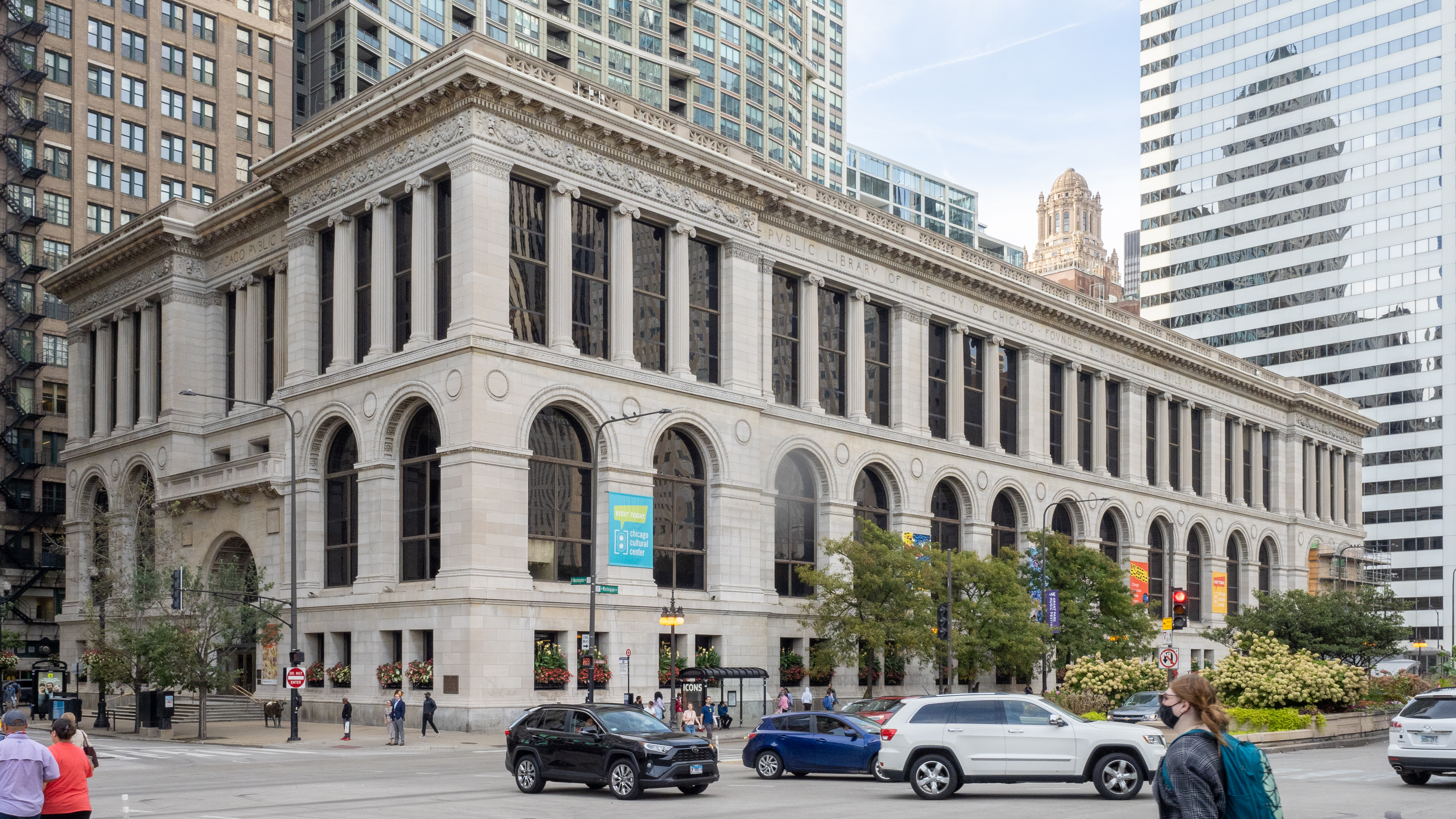
The Chicago Cultural Center itself carries a weight the curatorial team must read into. The building, designed by Shepley, Rutan and Coolidge and completed in 1897 as the city's original public library, is a Beaux-Arts civic monument whose Tiffany dome and mosaic interiors stand as one of the most photographed public-interior spaces in the United States, and one with an unambiguous nineteenth-century civic vocabulary about what a public room is for. To programme a contemporary architecture biennial inside that room is to make every curatorial decision a comment on the building's own argument. The continuing siting choice, at the Cultural Center first, with satellite venues at the Graham Foundation's Madlener House (1902, Richard E. Schmidt) and at the Stony Island Arts Bank (Theaster Gates's 2015 reactivation of a 1923 William Gibbons Uffendell bank on the South Side), keeps the biennial in conversation with the city's nineteenth- and early twentieth-century building stock at every turn. That is itself a curatorial argument about where contemporary practice should be made to answer.