Lahore Biennale

Pakistan's first international contemporary art biennial — held inaugurally in March 2018 across the historic sites of Lahore, organised by the Lahore Biennale Foundation (founded 2014 by Qudsia Rahim and Osman Khalid Waheed). Three editions in, the biennial has established itself as one of South Asia's principal contemporary art platforms.

Established2018 — 20243 editions
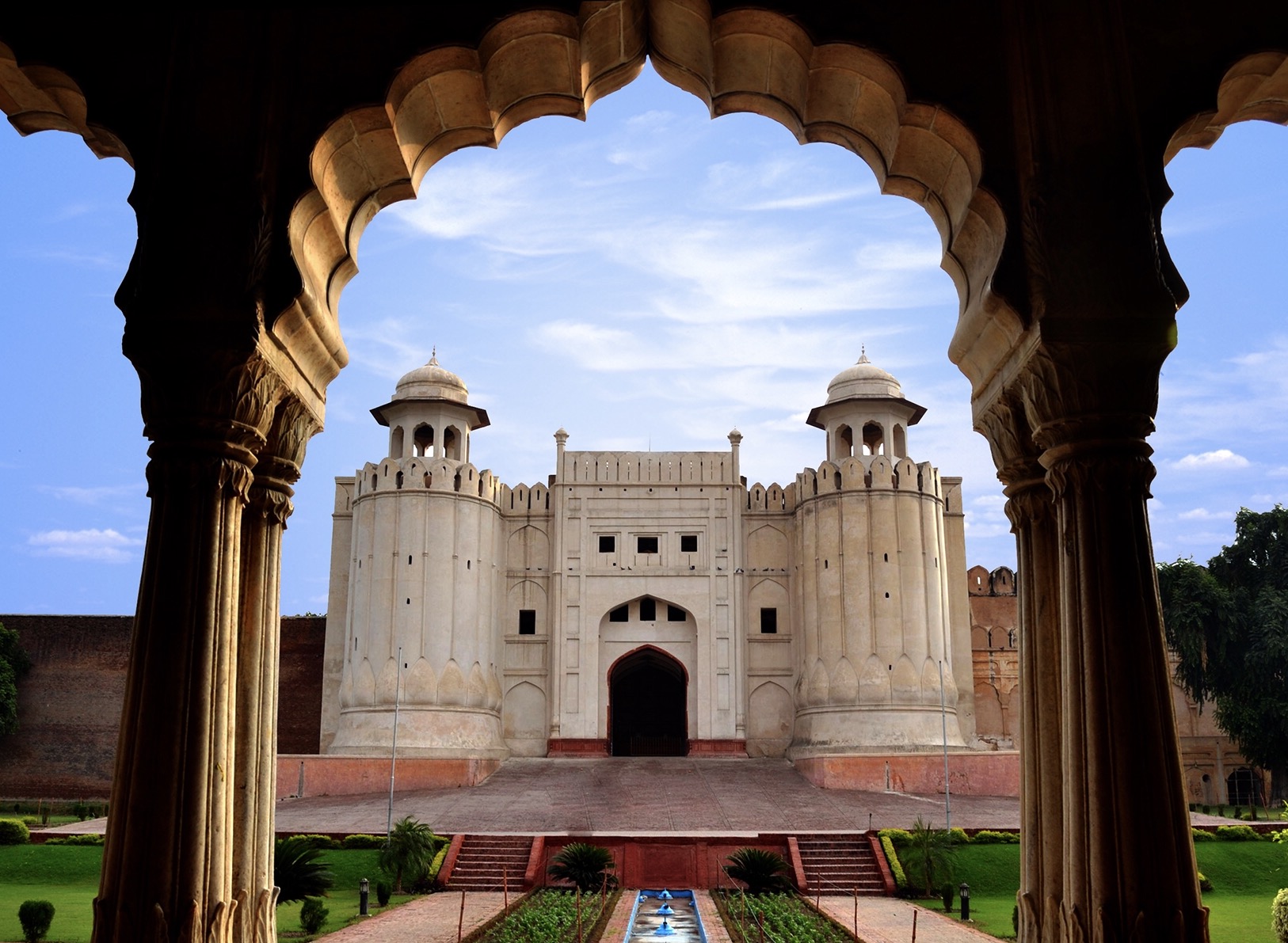
The Lahore Fort and Shalimar Gardens — principal historic venues of the Lahore Biennale since 2018.
Above Lahore — the Walled City, the Lahore Fort and the Shalimar Gardens have been the principal historic venues across the Lahore Biennale's three editions since the inaugural 2018 exhibition.

The Lead Essay The 3rd Edition, and What Came Before

Tain's Of Mountains and Seas

The 3rd Lahore Biennale, Of Mountains and Seas, opened on 5 October 2024 under curator John Tain — Head of Research at Asia Art Archive, Hong Kong — and ran to 8 November 2024 across a dozen venues citywide, with sixty-some participating artists from thirty countries. The 4th Biennale, under Nav Haq, is announced for 2027.

The Lahore Biennale is the international contemporary art biennial of Pakistan, organised by the Lahore Biennale Foundation (LBF) — a non-profit organisation established in 2014 by the artist and curator Qudsia Rahim and the Lahore-based businessman Osman Khalid Waheed. The first edition (LB01), held in March 2018, was led editorially by a curatorial team comprising Qudsia Rahim, Mariah Lookman and Zarmina Rafi, later joined by Iftikhar Dadi, Aziz Sohail and Amna Suheyl who programmed the performances, lectures, workshops and symposia. The first edition's institutional history is itself a matter of record: the artist Rashid Rana, named in 2014 as the founding artistic director, resigned in August 2017, and the inaugural edition was reorganised under the in-house LBF curatorial team in the months that followed.

The 3rd Lahore Biennale, Of Mountains and Seas, opened on 5 October 2024 and ran through 8 November 2024 across approximately a dozen venues citywide, with sixty-some participating artists from thirty countries. Its curator, John Tain — Taipei-born, Harvard- and UC Berkeley-trained, currently Head of Research at Asia Art Archive in Hong Kong, and previously a curator of modern and contemporary collections at the Getty Research Institute — selected ecologies and sustainable futures as the edition's principal subject, programming work that addressed the calamitous floods, agricultural disasters and urban environmental degradation that have reshaped life across South and Southeast Asia in recent years. The historic UNESCO World Heritage site of the Lahore Fort, used as a principal venue in the first two editions, was again the central historic site; the Shalimar Gardens — the great Mughal hydrological and garden ensemble — were programmed for the first time as a biennial venue.

The institutional argument across three editions

The Lahore Biennale's continuing institutional argument has been that an international contemporary art biennial sited in Lahore — programmed across historic sites that pre-date the contemporary biennial system by four centuries, in a city whose contemporary art education at the National College of Arts has produced one of South Asia's most consequential contemporary art generations — produces a different working relationship to the international biennial circuit than the relationship a biennial sited in a major Western capital can produce. The 2nd edition, between the sun and the moon, held from 26 January to 29 February 2020 under guest curator Hoor Al Qasimi (then and still President and Director of the Sharjah Art Foundation), opened just weeks before the COVID-19 pandemic closed international travel and operated with eighty-some artists' projects and more than twenty new commissions sited from Hazuri Bagh and the Lahore Fort to the PIA Planetarium.

LB04, scheduled to open in spring 2027 and to coincide with the eightieth anniversary of the Partition of British India and the founding of Pakistan, will be curated by the British-Pakistani curator Nav Haq, currently Associate Director at M HKA (Museum of Contemporary Art Antwerp). His announcement was made in February 2026. The curatorial framework Haq has set out — the vitality of society and culture across borders, and the capacity of art to generate new solidarities in a multipolar world — is the institutional commitment under which the LBF has framed the 80th-anniversary edition.

Critical Perspective Site-as-curation

Programming an art biennial across Mughal heritage sites

The Lahore Biennale's structural choice — to programme international contemporary art across Lahore's pre-modern architectural inheritance — has produced one of the more institutionally distinctive curatorial frames in the post-2010 biennial field.

The Lahore Biennale's most institutionally distinctive curatorial decision has been the choice of venue. Where most international biennials of the post-2000 period have been sited at contemporary art museums, repurposed industrial buildings, or purpose-built exhibition halls, the Lahore Biennale has consistently programmed across the city's pre-modern architectural inheritance — the Hazuri Bagh and Lahore Fort, the Wazir Khan Hammam, the Shahi Hammam, the gardens and courtyards of the Walled City. The institutional argument the choice makes is that contemporary art's institutional reception in a city like Lahore should not require — and should not even pretend to require — the contemporary museum infrastructure the European biennial tradition has organised itself around. The Mughal-era architecture, the colonial-era institutional sites, and the post-Partition contemporary venues are the inherited working spaces of the city; the Biennale's curatorial intelligence operates inside them.

The structural choice has produced both the Biennale's most-discussed editions and its most-contested ones. The 2nd edition under Hoor Al Qasimi (between the sun and the moon, 2020) sited new commissions across Hazuri Bagh, the Lahore Fort, and the PIA Planetarium — the institutional reading by the post-2020 international art press positioned the edition as one of the more curatorially-coherent South Asian biennials of the decade. The 3rd under John Tain (Of Mountains and Seas, 2024) extended the choice to a wider range of historic and contemporary sites across Lahore. The choice is not without cost: programming contemporary work in heritage sites requires sustained institutional negotiation with the cultural-heritage agencies that manage those sites, and the conservation conditions the sites require limit which kinds of contemporary work can be programmed at all.

The continuing question the Biennale's site-as-curation choice raises is whether the format scales — whether the institution can continue to programme at the institutional ambition the first three editions achieved, given the structural constraints the heritage-site choice imposes. The LBF's continuing institutional commitment to the model, the announcement of Nav Haq for LB04 in 2027, and the alignment of the 80th-anniversary edition with the Partition anniversary, suggests the institution is committed to the model across at least one more cycle. Whether that cycle can produce the institutional argument the founding editions established is the editorial question the next two years will answer.


The Institutional Spine

Defining moments

Five episodes from the establishment of Pakistan's international biennial.

2014Foundation

LBF established

The Lahore Biennale Foundation was established in 2014 by the artist and curator Qudsia Rahim and the Lahore-based businessman Osman Khalid Waheed, as a non-profit organisation devoted to producing Pakistan's first international contemporary art biennial. The Foundation also runs continuing programmes in public art, cultural heritage, education and research across the city. The artist Rashid Rana was named the first edition's artistic director in 2014; he resigned in August 2017, after which the inaugural edition was reorganised under the LBF in-house curatorial team.

Sources: LBF — Qudsia Rahim; The News on Sunday, 2017

2018LB01

The inaugural Lahore Biennale

The first Lahore Biennale (LB01) opened on 18 March 2018 across historic venues of the Walled City and the Lahore Fort, programmed under a curatorial team led by Qudsia Rahim, Mariah Lookman and Zarmina Rafi, with Iftikhar Dadi, Aziz Sohail and Amna Suheyl on performances, lectures and the symposia programme. The edition established the Biennale's working pattern of siting contemporary art within Mughal- and colonial-era venues, and the institutional pattern of an LBF in-house curatorial team developing each edition.

Sources: Frieze, 2018; LBF archive

2020LB02

Al Qasimi's between the sun and the moon

The second Lahore Biennale (LB02), between the sun and the moon, opened on 26 January 2020 and closed on 29 February 2020 — weeks before the World Health Organization's COVID-19 pandemic declaration. Guest curator Hoor Al Qasimi (President and Director of the Sharjah Art Foundation) programmed eighty-some artists' projects with more than twenty new commissions, sited across the Lahore Fort, Hazuri Bagh, the PIA Planetarium and other historic locations. The edition introduced a curatorial premise of cosmological orientation, asking how communities historically organised by reference to the sun, moon and constellations might reconceive their relationship to climate and to one another.

Sources: e-flux, 2020; Daily Times Pakistan, 2020

2024LB03

Tain's Of Mountains and Seas

The 3rd Lahore Biennale (LB03), Of Mountains and Seas, opened on 5 October 2024 and ran through 8 November 2024 under curator John Tain. Sixty-some artists from thirty countries presented site-specific work across approximately a dozen citywide venues, including the UNESCO World Heritage Lahore Fort and — for the first time as a biennial venue — the Shalimar Gardens. The edition's theme of ecologies and sustainable futures responded to the flooding and environmental degradation that have reshaped life across South and Southeast Asia.

Sources: e-flux, 2024; DAWN, 2024

2027LB04 · announced

Haq's Partition-anniversary edition

LB04 was announced in February 2026 with the appointment of Nav Haq — British-Pakistani curator and Associate Director at M HKA Antwerp — as curator. The edition is scheduled for spring 2027 and timed to coincide with the eightieth anniversary of the Partition of British India and the founding of Pakistan. Haq's announced curatorial framework engages the vitality of society and culture across borders and the capacity of contemporary art to generate new solidarities in a multipolar world.

Sources: Artforum, February 2026; LBF

People in the Biennale

The figures behind Lahore

Curator · LB03 (2024)

John Tain

Curator and researcher; Head of Research at Asia Art Archive, Hong Kong. Born in Taipei; BA in Social Studies and Fine Arts, Harvard College; postgraduate work in art history at the University of California, Berkeley. Previously a curator of modern and contemporary collections at the Getty Research Institute, where he developed acquisitions related to Ed Ruscha, Allan Sekula, Faith Wilding and Tetsumi Kudo. Curator of the 3rd Lahore Biennale, Of Mountains and Seas, 2024.

Source: Lahore Biennale Foundation

Guest curator · LB02 (2020)

Hoor Al Qasimi

Emirati curator (b. 1980). President and Director of the Sharjah Art Foundation, which she founded in 2009; Director of the Sharjah Biennial since 2002 and curator of Sharjah Biennial 15 (2023). President of the International Biennial Association since 2017, and Artistic Director of the 25th Biennale of Sydney (March–June 2026). Guest curator of the 2nd Lahore Biennale, between the sun and the moon, 2020.

Source: Wikipedia; Sharjah Art Foundation

Curator · LB04 (announced 2027)

Nav Haq

British-Pakistani curator and writer; Associate Director at M HKA (Museum of Contemporary Art Antwerp). Announced in February 2026 as curator of the 4th Lahore Biennale (LB04), scheduled to open in spring 2027, coinciding with the 80th anniversary of the Partition of British India and the founding of Pakistan. His curatorial framework for LB04 will examine the vitality of society and culture across borders and the capacity of art to generate new solidarities in a multipolar world.

Source: Artforum, February 2026; LBF

Co-founder & Executive Director · LBF

Qudsia Rahim

Pakistani artist and curator; co-founder and Executive Director of the Lahore Biennale Foundation (founded 2014). Graduate of the National College of Arts, Lahore, and Alfred University, New York; taught sculpture at Alfred University for two years before returning to Pakistan. Co-curator of the inaugural Lahore Biennale, 2018.

Source: Lahore Biennale Foundation

Curatorial team · LB01 (2018)

Iftikhar Dadi

Pakistani-American artist, art historian and curator. John H. Burris Professor and Chair of the Department of History of Art at Cornell University. Member of the inaugural Lahore Biennale's curatorial team (LB01, 2018), responsible alongside Aziz Sohail and Amna Suheyl for performances, lectures and the symposium programme. Author of Modernism and the Art of Muslim South Asia (2010) and one of the principal scholars of contemporary South Asian art in the post-1990 institutional record.

Source: Wikipedia

Continuing institutional figure · Pakistani contemporary art

Salima Hashmi

Pakistani painter, curator and arts educator (b. 1942). Daughter of the poet Faiz Ahmed Faiz. Former Principal of the National College of Arts, Lahore (1999–2003), and Dean of the School of Visual Arts at Beaconhouse National University. Among the most consequential figures in the institutional history of contemporary Pakistani art across the post-1980 period; her continuing curatorial and educational work has shaped the curatorial generation from which the Lahore Biennale's institutional team has been drawn.

Source: Wikipedia

Inaugural edition
2018
Foundation
LBF · founded 2014
Format
Citywide · historic sites
Host city
Lahore, Pakistan
Co-founders
Rahim · Waheed

Geography

The Biennale across the Walled City

Principal historic venues

Lahore Fort

UNESCO World Heritage Site · principal venue across all three editions

Walled City of Lahore
Lahore, Punjab, Pakistan

Shalimar Gardens

Mughal hydrological ensemble · used for the first time at LB03 (2024)

Grand Trunk Road
Lahore, Punjab, Pakistan

Hazuri Bagh

LB02 (2020) inauguration venue

Between Lahore Fort and Badshahi Mosque
Lahore, Pakistan

Additional citywide venues

PIA Planetarium, Bagh-e-Jinnah, NCA, and other sites across the city

Multiple locations across Lahore

From the Directory

Related biennials across South Asia and the Gulf

Browse the region →

Essential Reading

For further work

Lahore Biennale Reader 01

Lahore Biennale Foundation  ·  2018

The reader published in conjunction with the inaugural Lahore Biennale.

Lahore Biennale 02 — between the sun and the moon

Hoor Al Qasimi, curator  ·  LBF  ·  2020

Catalogue of the second edition, curated by Hoor Al Qasimi.

Lahore Biennale 03 — Of Mountains and Seas

John Tain, curator  ·  LBF  ·  2024

Programme of the third edition, curated by John Tain.

Institutional record

Editorial content on biennale.com is published by the Biennale Editorial Team. Image credits as captioned. External links are provided for reference and verification.