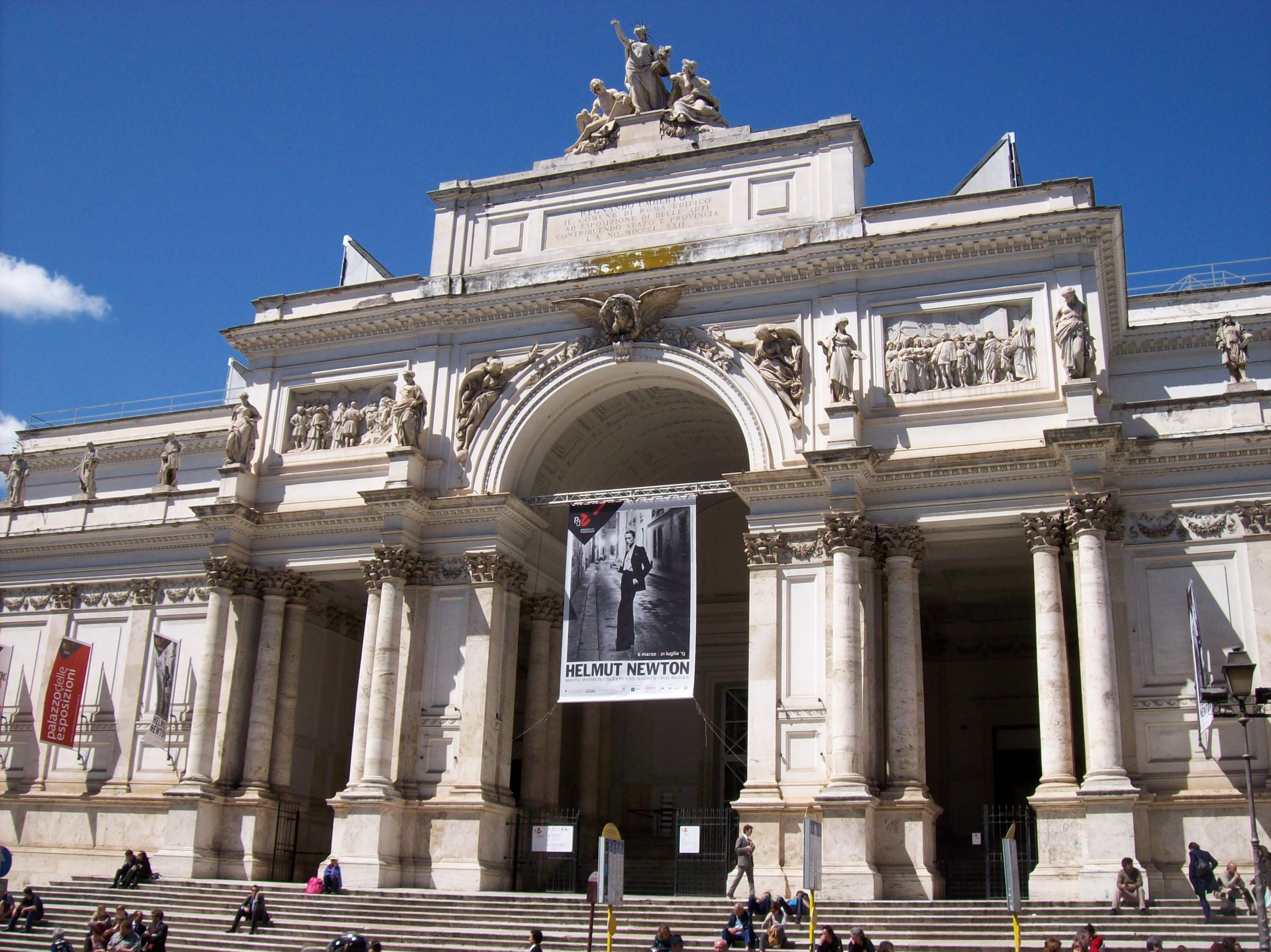
The Quadriennale di Roma is the Italian national institution charged with the periodic survey of contemporary Italian art. It was founded in 1927 by Cipriano Efisio Oppo (artist, writer, member of Parliament and director of the artists' trade union under the Fascist regime) by resolution of the Governorate of Rome, as part of a broader institutional reorganisation of Italian exhibitions intended to give the country, alongside the Venice Biennale (founded 1895) and the Milan Triennale (founded 1923), a third structuring exhibition: a national quadrennial dedicated specifically to Italian art. The first Quadriennale opened at the Palazzo delle Esposizioni on Via Nazionale in January 1931 under Oppo's direction as general secretary, and the second followed in 1935. In 1937 the institution was established as an autonomous body in its own right.
The 18th Quadriennale d'arte, Fantastica, opened on 11 October 2025 at the Palazzo delle Esposizioni and runs to 18 January 2026. The edition is structured around five curatorial paths developed independently by five curators (Luca Massimo Barbero, Francesco Bonami, Emanuela Mazzonis di Pralafera, Francesco Stocchi and Alessandra Troncone), together with a historical section curated by Walter Guadagnini drawing on the Quadriennale's Library Archive. The exhibition presents fifty-four living Italian artists born between the 1960s and the late 1990s (sixteen of them under thirty-five), with one hundred and eighty-seven works installed across approximately 2,000 square metres of the Palazzo's ground floor, including a significant body of site-specific productions. Forty-five of the artists are participating in the Quadriennale for the first time.
A national format, retooled across five curatorial points of view
The structural argument of Fantastica is that the most consequential reading of the first twenty-five years of twenty-first-century Italian art is not a single curatorial position but a federated one. Each of the five curators developed an independent path: Barbero on self-portraiture; Bonami on freedom and independence; Stocchi on the centrality of the artist; Mazzonis di Pralafera on photography as a language of revelation; and Troncone's incomplete body on human and non-human forms as evolving narrative fields. Guadagnini's historical section draws on the Quadriennale's archive to read the contemporary work against the institution's own ninety-eight-year record. The exhibition's title, Fantastica, in tribute to art's capacity to open new horizons, is the editorial through-line.
The institutional argument behind the federated format is the Quadriennale's continuing position as the only national-scale Italian exhibition wholly given over to contemporary Italian art. The Venice Biennale is international and curated to an international visitor; the Milan Triennale is design and architecture; the Quadriennale is the format in which Italian art is the subject. Across the post-war period the institution sustained that position under a sequence of state and municipal arrangements, and from 2005 onward as a Foundation jointly supported by the Italian Ministry of Culture and the Municipality of Rome, with its head office relocated to the seventeenth-century Villa Carpegna in the Aurelio district.
The immediate institutional precedent is the 17th Quadriennale, FUORI, which opened at the Palazzo delle Esposizioni on 30 October 2020, programmed under pandemic conditions, and ran through July 2021, after several extensions. FUORI was curated by Sarah Cosulich, then artistic director of the Foundation, and Stefano Collicelli Cagol, and was the result of more than two years of studio visits, portfolio reviews and archival work. The edition presented forty-three artists (more than half of them under forty, with a significant female presence) and built unexpected intergenerational bridges between Italian art of the 1960s and the present, structured around the three thematic lines of the palace, desire and the incommensurable. The 2020 edition is widely understood to have rewritten the Quadriennale's curatorial premise away from a survey of recent practice and toward a properly curated exhibition.