Seoul Mediacity Biennale

The Seoul Museum of Art's biennial of media and digital art — inaugurated in 2000 as Media_City Seoul at the dawn of the city's millennial cultural project, programmed since then through thirteen editions, and currently one of Asia's principal continuing platforms for the moving image, sound, performance and media-arts experiment.

Established2000 — 202513 editions
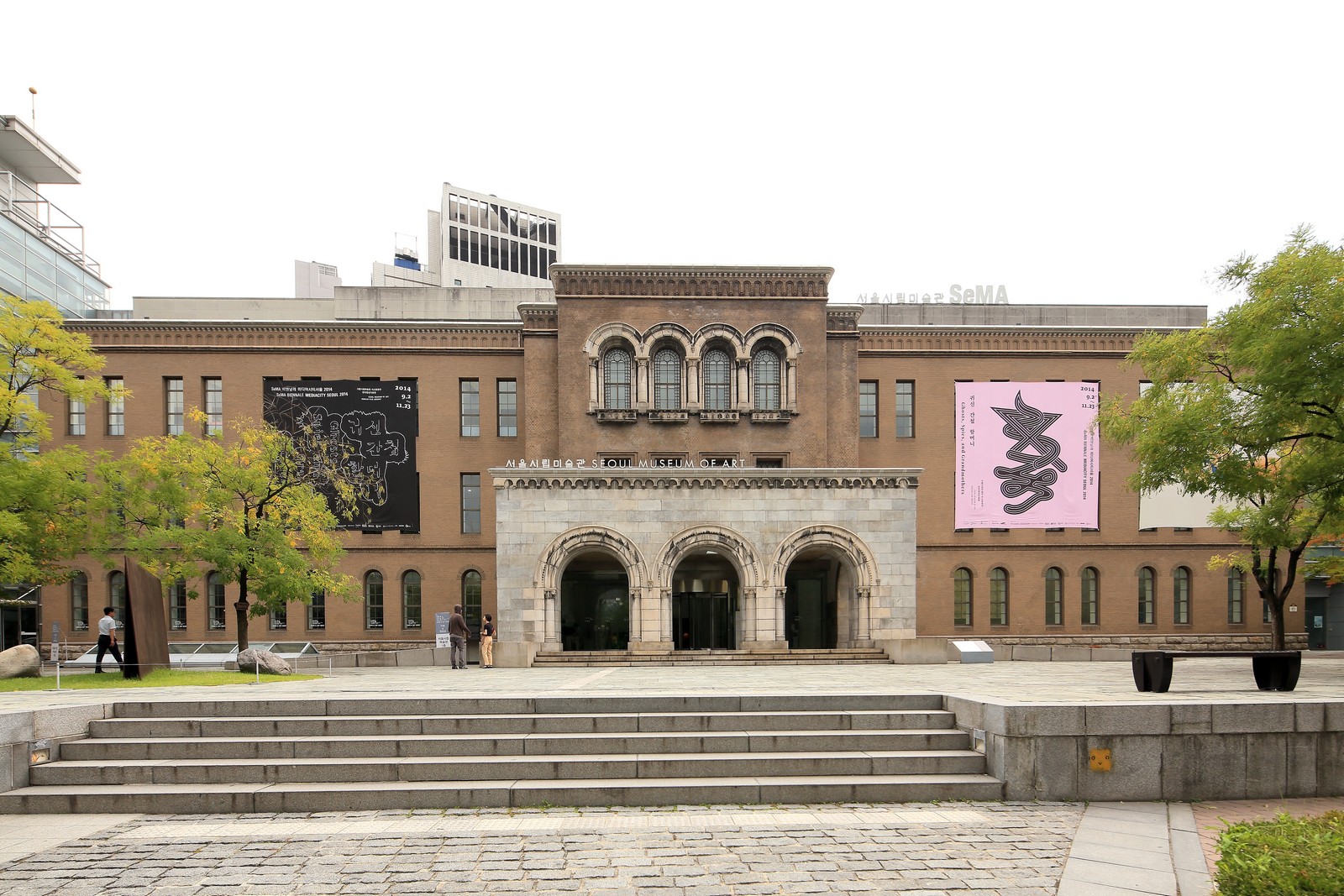
Seoul Museum of Art — host institution of every Seoul Mediacity Biennale since 2000.
Above The Seoul Museum of Art (SeMA) — host institution of every Seoul Mediacity Biennale since the inaugural Media_City Seoul in 2000, programmed across SeMA's principal building and across additional citywide venues each edition.

The Lead Essay The 13th Edition

Vidokle, Ayres & Brasiskis's Séance: Technology of the Spirit

The 13th Seoul Mediacity Biennale, Séance: Technology of the Spirit, opened at SeMA on 26 August 2025 and ran through 23 November under co-directors Anton Vidokle, Hallie Ayres and Lukas Brasiskis. The edition foregrounded spiritual, mystical and occult traditions as alternative forms of technology — a curatorial argument that has, since the founding 2000 edition, been entirely uncharacteristic of the SeMA Biennale's lineage.

The Seoul Mediacity Biennale is the Seoul Museum of Art's biennial of media art. It traces its lineage to a precursor series — the SEOUL in MEDIA exhibitions, presented three times between 1996 and 1999 — and was inaugurated as a biennial in 2000 under the name Media_City Seoul, programmed as part of the Seoul Metropolitan Government's Millennium Project. The institution's founding argument was that Seoul, then in the early years of its post-industrial cultural-policy reordering, needed a continuing biennial venue at which the moving image, the digital, sound, performance and the wider media-arts field could be programmed at sustained institutional weight. Twenty-five years on, the Biennale has held to that constituting subject more consistently than any of its Asian peers.

The 13th edition, Séance: Technology of the Spirit, opened at SeMA on 26 August 2025 and ran through 23 November under three co-directors: the artist and e-flux founder Anton Vidokle (b. Moscow, 1965; based New York and Berlin), the New York-based curator and art historian Hallie Ayres, and the Vilnius-trained scholar of experimental film and media theory Lukas Brasiskis. The edition's curatorial argument took spiritual, mystical and occult traditions as forms of alternative technology — a position that draws directly on Vidokle's continuing artistic and curatorial work on Russian Cosmism and on the broader e-flux journal's ongoing engagement with the relationship between cosmotechnics and the contemporary moving image. The programme extended across the Seoul Museum of Art, NAKWON SANGGA, the Seoul Art Cinema and the Seoul Artists' Platform_New&Young, with exhibition, performance and film screenings programmed in parallel.

An institution that selects by open call

One structural feature distinguishes the Seoul Mediacity Biennale from its peers: since the 12th edition (2023), the Artistic Director has been selected by open call, a process the SeMA Biennale was the first major media-arts biennial to adopt formally. The 12th edition, THIS TOO, IS A MAP, ran at SeMA and across several citywide venues from 21 September to 19 November 2023 under Artistic Director Rachael Rakes, with Associate Curator Sofía Dourron, and the SeMA in-house Biennale team led by Kwon Jin; Annie Jael Kwan and Ong Jo-Lene served as Program Advisors. Rakes's curatorial premise was the subversion of the cartographic and the construction of a non-territorial aesthetics — a position the Korean and international press read as one of the strongest in the SeMA Biennale's recent history.

The 11th edition, One Escape at a Time, was directed by Yung Ma and opened at SeMA on 8 September 2021 after a year's pandemic postponement. The edition's premise — escapism reframed as a navigational instrument for fractured contemporary realities — drew its title from the US sitcom One Day at a Time (2017–20), and presented 58 works by 41 Korean and international artists across moving image, installation, photography, painting, drawing, sculpture, music and performance. Across its thirteen editions, the SeMA Biennale has remained one of the very few continuing Asian biennials whose constituting subject is the moving image and the wider media-arts field, rather than the contemporary art field broadly.

Critical Perspective The Seoul model

An open-call Artistic Director — A bet against the curator-celebrity economy

Since the 12th edition (2023), the Seoul Mediacity Biennale has selected its Artistic Director by open call — the first major Asian media-arts biennial to formalise that model. The institutional argument is that the international biennial circuit has become structurally dependent on a small, repeatedly-recirculated cohort of celebrity curators, and that an open-call model is a continuing structural critique of that dependency.

The international biennial circuit, across roughly thirty years of post-1989 expansion, has produced its own curator-celebrity economy. The same hundred-or-so figures circulate, in continuing rotation, across the biennials and triennials of Venice, São Paulo, Gwangju, Sharjah, Istanbul, Manifesta, Lyon, Liverpool, Sydney and the rest. The structural consequence is well-documented: a continuing curatorial conversation that, despite repeated programmatic gestures toward diversity, has remained organised around the institutional and intellectual networks of a relatively small Euro-American-Asian curatorial class.

The Seoul Mediacity Biennale's open-call appointment model is one of the very few continuing structural responses to that problem. Since the 12th edition (2023), the SeMA Biennale has selected its Artistic Director by open call: a published application process under which a candidate's curatorial proposal — rather than the candidate's name and institutional position — is the working basis for selection. The 12th edition under Rachael Rakes was the first programmed under this model; the 13th under Anton Vidokle, Hallie Ayres and Lukas Brasiskis continued it.

The institutional argument is that a city-museum biennial of media art — sited at SeMA and organised by the Seoul Metropolitan Government — has the structural independence to make a different curatorial bet than the international biennial circuit can. The continuing question is whether the open-call model can sustain programmatic weight across multiple cycles: whether the curatorial proposals selected through open call can develop the institutional inheritance that the curator-celebrity model trades on, and whether the international press will continue to engage Seoul's biennial at the same critical register it engages Venice or Sharjah.

The 12th and 13th editions, taken together, suggest the answer so far is yes. Rakes's THIS TOO, IS A MAP was read in the international press as one of the sharper editions of any Asian media-arts biennial in the recent cycle, and Vidokle, Ayres and Brasiskis's Séance opened in August 2025 to substantial international engagement. What the institutional record will continue to demonstrate is whether the open-call model can hold across the next three or four cycles — and whether other major biennials will adopt the structure that SeMA has demonstrated can work.

The Institutional Spine

Defining moments

Five episodes from twenty-five years of Asia's principal media-arts biennial.

20001st edition · Media_City Seoul

Media_City Seoul

The inaugural Seoul Mediacity Biennale — then titled Media_City Seoul — opened in 2000 as part of the Seoul Metropolitan Government's Millennium Project. The institution traced its lineage to the SEOUL in MEDIA exhibitions held three times between 1996 and 1999 and was conceived to position Seoul as a global hub for media arts and digital culture at the dawn of the new millennium. Hosted by the Seoul Metropolitan Government and organised by the Seoul Museum of Art (SeMA), the founding institutional argument has held across all subsequent editions.

Sources: SMB — About; Biennial Foundation

202111th edition

Yung Ma's One Escape at a Time

The 11th Seoul Mediacity Biennale, One Escape at a Time, was directed by Yung Ma and opened at SeMA on 8 September 2021 after a year's pandemic postponement, running through November 2021. The edition's premise reframed escapism as an instrument for navigating contemporary fractures, with the US sitcom One Day at a Time (2017–20) as a structuring reference. Fifty-eight works by forty-one Korean and international artists were presented.

Sources: e-flux, 2021; Korea Herald, 2021

202312th edition

Rakes's THIS TOO, IS A MAP

The 12th Seoul Mediacity Biennale, THIS TOO, IS A MAP, opened on 21 September 2023 and ran through 19 November at SeMA and citywide venues under Artistic Director Rachael Rakes, with Associate Curator Sofía Dourron and the SeMA Biennale team led by Kwon Jin. Annie Jael Kwan and Ong Jo-Lene were Program Advisors. The 12th was the first edition under SeMA's new open-call Artistic Director selection process, instituted in place of the previous recommendation-based model. Rakes's curatorial argument was the subversion of cartographic mapping and the production of a non-territorial aesthetics.

Sources: e-flux, 2023; Korea Herald, March 2023

202513th edition · current

Vidokle, Ayres & Brasiskis's Séance

The 13th Seoul Mediacity Biennale, Séance: Technology of the Spirit, opened at SeMA on 26 August 2025 and ran through 23 November under co-directors Anton Vidokle, Hallie Ayres and Lukas Brasiskis. The edition's curatorial premise foregrounded spiritual, mystical and occult traditions as alternative forms of technology, challenging the prevailing capitalist and rationalist technological systems. The programme extended across SeMA, NAKWON SANGGA, the Seoul Art Cinema and the Seoul Artists' Platform_New&Young.

Sources: e-flux; The Art Newspaper, 27 August 2025

ContinuingSelection process

Open-call Artistic Director model

Since the 12th edition (2023), the Artistic Director of the Seoul Mediacity Biennale has been selected by open call rather than recommendation — a structural reform the institution has framed as a commitment to programmatic diversity and to opening the Artistic Director role beyond established curatorial networks. The 12th edition under Rachael Rakes was the first to be programmed under the new model; the 13th continues it.

Sources: e-flux, AD appointment, 2022

People in the Biennale

The figures behind Seoul Mediacity

Co-director · 13th edition (2025)

Anton Vidokle

Artist and editor (b. Moscow, 1965; lives New York and Berlin). Founder of e-flux (1998), the publishing platform, archive and cultural enterprise; co-founder of the e-flux journal (2008, with Brian Kuan Wood and Julieta Aranda); co-curator of the cancelled Manifesta 6 (2005) and founder of the Unitednationsplaza independent project in Berlin (2006–07). His current artistic practice, working principally in film, focuses on Russian Cosmism — the school of thought developed by the librarian Nikolai Fedorov (1828–1903) which sought to unite science, technology, religion and art.

Source: Wikipedia

Co-director · 13th edition (2025)

Hallie Ayres

Curator and art historian, New York. Co-director of the 13th Seoul Mediacity Biennale, Séance: Technology of the Spirit, 2025. Her recent curatorial and editorial work, in continuing collaboration with Anton Vidokle and Lukas Brasiskis, has addressed the relationship between cosmotechnics, alternative spiritual traditions and contemporary moving-image practice.

Source: Seoul Mediacity Biennale

Co-director · 13th edition (2025)

Lukas Brasiskis

Lithuanian-born scholar of experimental film and media theory. Co-director of the 13th Seoul Mediacity Biennale, Séance: Technology of the Spirit, 2025. His scholarly and curatorial work addresses experimental and non-fiction moving-image practices and their relationship to broader media theory and to philosophical questions of technology and the spiritual.

Source: Seoul Mediacity Biennale

Artistic Director · 12th edition (2023)

Rachael Rakes

Curator and editor, New York. Artistic Director of the 12th Seoul Mediacity Biennale, THIS TOO, IS A MAP, 2023 — the first SeMA Biennale Artistic Director selected by open call. Her continuing curatorial and editorial practice has addressed contemporary moving-image practice, decolonial cartography and the question of the non-territorial.

Source: Seoul Mediacity Biennale

Artistic Director · 11th edition (2021)

Yung Ma

Curator. Artistic Director of the 11th Seoul Mediacity Biennale, One Escape at a Time, 2021. Previously Associate Curator of Moving Image at the Centre Pompidou, Paris (2014–18), and Curator at M+ Hong Kong. His curatorial practice has consistently addressed the moving image, the digital and the post-internet field.

Source: e-flux, 2021

Organising institution — continuing

Seoul Museum of Art (SeMA)

The municipal contemporary art museum of the Seoul Metropolitan Government, with its principal building at Seosomun. SeMA has organised the Seoul Mediacity Biennale across all thirteen editions since the inaugural Media_City Seoul in 2000, and has been the institutional architect of the post-2023 open-call Artistic Director model. The continuing institutional commitment — across municipal-government cycles — is the structural condition under which the SeMA Biennale's distinctive curatorial register has been programmed.

Source: Seoul Museum of Art

Inaugural edition
2000
Precursor series
SEOUL in MEDIA · 1996–99
Format
Biennial · media art
Host city
Seoul, South Korea
Organiser
Seoul Museum of Art

Geography

The Biennale at SeMA and across Seoul

Principal venues — 13th edition

Seoul Museum of Art (SeMA)

Principal venue across every edition since 2000

61 Deoksugung-gil, Jung-gu
Seoul 04515, South Korea

NAKWON SANGGA

Extended venue · 13th edition

Nakwon-dong, Jongno-gu
Seoul, South Korea

Seoul Art Cinema

Film programme venue · 13th edition

Jongno-gu
Seoul, South Korea

Seoul Artists' Platform_New&Young

Performance and emerging-artists venue · 13th edition

Seoul, South Korea

From the Directory

Related biennials across Asia-Pacific

Browse the region →

Essential Reading

For further work

11th Seoul Mediacity Biennale — One Escape at a Time

Yung Ma, Artistic Director  ·  SeMA  ·  2021

Programme of the 11th edition, opened after a year's pandemic postponement.

12th Seoul Mediacity Biennale — THIS TOO, IS A MAP, AN ANTHOLOGY

Rachael Rakes, Artistic Director  ·  SeMA  ·  2023

Anthology published in conjunction with the 12th edition.

13th Seoul Mediacity Biennale — Séance: Technology of the Spirit

Vidokle, Ayres & Brasiskis, co-directors  ·  SeMA  ·  2025

Programme of the 13th edition, currently the most recent.

From the news desk

Institutional record

Editorial content on biennale.com is published by the Biennale Editorial Team. Image credits as captioned. External links are provided for reference and verification.