Andorra Land Art

The Pyrenean microstate biennial of land art and contemporary landscape practice, founded in 2015 in the Principality of Andorra as the Biennal Internacional d'Andorra and rebranded L'ANDART from the third edition in 2019. Organised by the Government of Andorra Ministry of Culture together with the Commune of Sant Julià de Lòria and a consortium of public and private sponsors, with curator Pere Moles and art director Albert Gusi. The sixth edition, Pausa per continuar (Pause to Continue), runs from 19 September to 14 November 2025 across the historic Hotel Pol and a thirty-five-kilometre Panoramic Route through the southern Pyrenean parish, with Liechtenstein as guest country.

Established2015 — 20266 editions
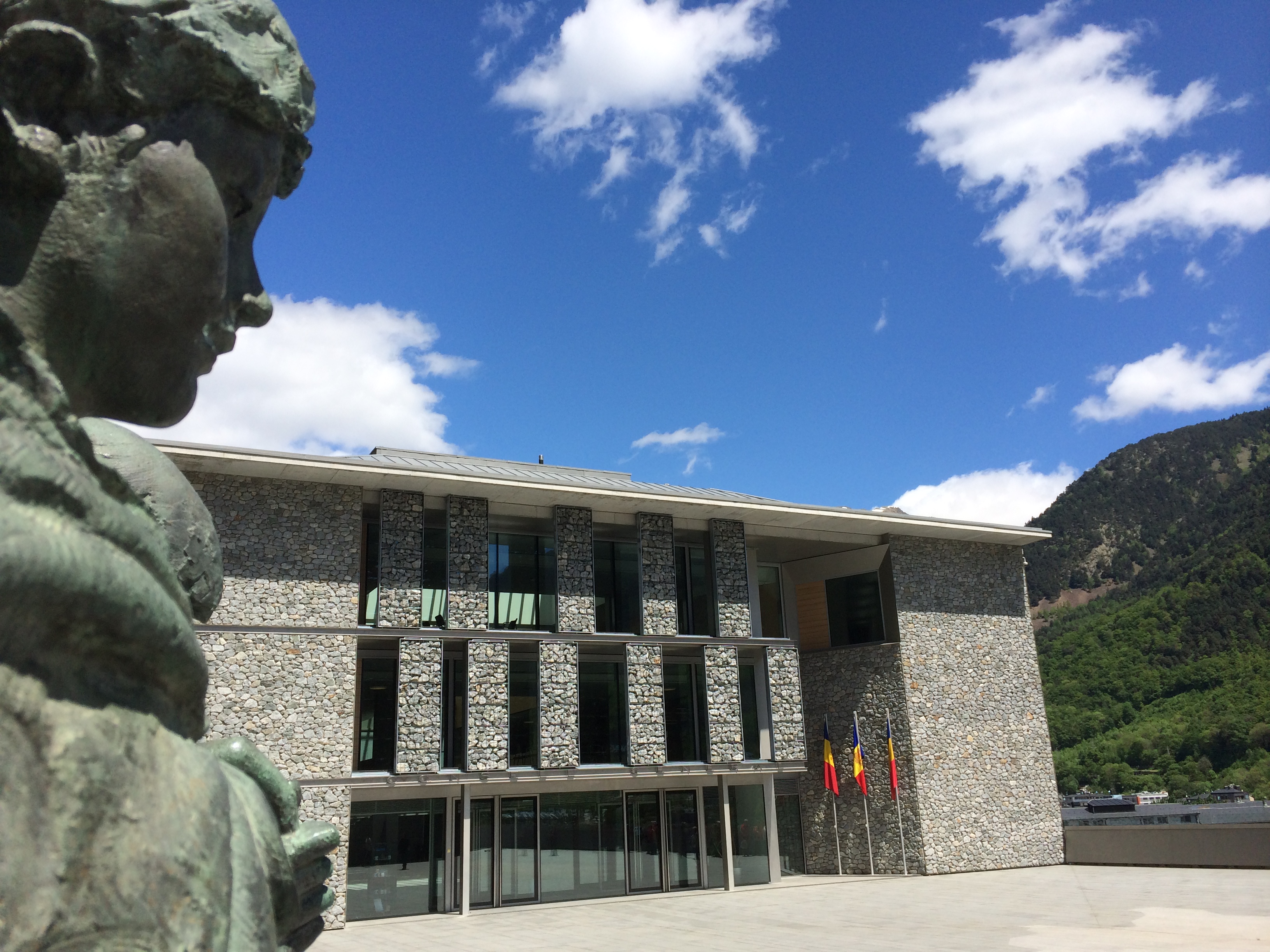
The southern Andorran parish of Sant Julià de Lòria, the host venue of L'ANDART since 2023 — the lowest settlement of the principality at 908 metres above sea level, set against the Pyrenean massif of the Eastern Pyrenees.
Above Sant Julià de Lòria, the southernmost parish of the Principality of Andorra and the host of L'ANDART since the fifth edition (2023). The town centre sits at 908 metres above sea level on the right bank of the Gran Valira river, with the surrounding parish ranging up to the 2,621-metre Pic Negre Nord — the Pyrenean landscape that is both the institutional setting and the continuing curatorial subject of the biennial.

The Lead Essay The 6th Biennal Internacional d'Andorra

Moles and Gusi's Pausa per continuar

The 6th Biennal Internacional d'Andorra — L'ANDART 25, under the title Pausa per continuar (Pause to Continue) — runs from 19 September to 14 November 2025 with curator Pere Moles and art director Albert Gusi. The edition takes a critical pause as its constituting figure: a deliberate moment of contemplation, after a first quarter of the twenty-first century in which urban growth, energy transition and the climate question have remade the relationship between mountain communities and the global cultural economy. The programme is articulated across the historic Hotel Pol — a 1931 building reopened for the biennial — and a thirty-five-kilometre Panoramic Route through the parish of Sant Julià de Lòria. Liechtenstein is the edition's guest country.

Andorra Land Art — programmed as L'ANDART from 2019 and known across its first two editions as the Biennal Internacional d'Andorra — is the biennial of land art and contemporary landscape practice of the Principality of Andorra, the Pyrenean microstate of roughly eighty thousand inhabitants set between France and Spain along the eastern Pyrenees. The institution was founded in 2015 under an organisation initialised ALA 2015, with curator Pere Moles, who had developed the project from 2012; the art directorship has been held across the editions to date by Albert Gusi. The biennial is convened by the Government of Andorra Ministry of Culture together with the Commune of Sant Julià de Lòria, Andorra Tourism, FEDA, Andorra Telecom and the Sorigué Foundation, the consortium of public and private sponsors that sustains the programme.

The sixth edition opens on 19 September 2025 and closes on 14 November under the title Pausa per continuar. The thesis the edition advances — that the first quarter of the twenty-first century has been characterised by an accelerating set of cultural, economic and environmental transformations, and that the present moment calls for a deliberate critical pause across questions of urban growth, public policy and the sustainability of cultural-economic models — is articulated as both an artistic and a civic argument: a stocktaking that the institution invites the artist and the visitor to undertake jointly, across the mountain landscape of southern Andorra and the historic urban fabric of Sant Julià de Lòria. The programme assembles seventy-eight artists from twenty nationalities and sixty-three works across sculpture, installation, video, photography and site-specific projects, with Liechtenstein — the German-speaking Alpine microstate of roughly forty thousand inhabitants, brought into the programme through cooperation with the Andorran Ministry of Foreign Affairs and Visarte Liechtenstein — as the edition's guest country.

An institution that maps a country onto a contemporary practice

The structural argument the biennial makes in its founding statement — that the institution is engaged in the construction of a contemporary landscape, a reinterpretation of place, region and country through artistic intervention, where the work is inserted into the territory with a set of aesthetic codes much as a tattoo is inserted into the human body — gives the programme its distinctive editorial position within the European biennial circuit. The land-art reference is direct: the institution takes the historical land-art movement of the late 1960s and early 1970s as its working tradition, but the Andorran programme departs from the American Western desert that anchored the founding land art of Smithson, Heizer and De Maria, and from the British landscape lineage of Long and Goldsworthy, to insist that the Pyrenean mountain valley — small, populated, juridically singular as a co-princedom under French and Episcopal Co-Princes — is itself a continuing curatorial subject. The first edition in 2015 staged work across the parishes of the principality, with a particular concentration at the Parc Natural de Sorteny in Ordino. The second edition (2017) was organised across four exhibition axes — the Path of Human Rights, the Wool Factory, the Viewpoints and the Zona Ras pedagogical-mediation site at Lake Engolasters. The third edition (2019) carried the rebranding to L'ANDART under the theme Shinrin-yoku (forest bathing), concentrated in the forested area around Lake Engolasters. The fourth edition (2021) opened to the question "What if we had to confine ourselves to the mountains?", a pandemic-era programme of forty-eight works around Engolasters and the Central Park of Andorra la Vella.

The fifth edition in 2023, titled The Mountains in Circulation, made Sant Julià de Lòria the host parish and took as its principal indoor venue the former CATSA tobacco factory in the Les Arades area — a disused industrial space that had operated as a tobacco factory and, from 2011 to 2016, as the headquarters of the Sabors i Aromes cooperative for the promotion of the Andorran trumfa potato and medicinal plants. The recovery of the abandoned factory as the institutional centre of the biennial was made the explicit symbolic argument of the edition: the circular economy of materials, of buildings and of cultural attention. The guest country was San Marino, the Italian-peninsula republic that is the world's other long-standing microstate biennial-eligible cultural partner. The sixth edition has retained Sant Julià de Lòria as the host but moved the indoor centre of gravity to the historic Hotel Pol — a 1931 building that across the twentieth century housed refugees from the Spanish Civil War and the Second World War, served as a social and political meeting point for the parish, and now reopens as the institutional anchor of L'ANDART 25, its rooms, corridors, kitchen and common spaces transformed into the galleries of a single building-wide contemporary art exhibition. The Panoramic Route — thirty-five kilometres long, with eleven works installed at sites including Plaça del Solà, Coll de Jou, Fontaneda, Canòlich, Bixessarri and Aixovall — extends the programme out into the wider mountain landscape, a three-hour walking-and-driving itinerary that operates as the institution's open-air museum.
Critical Perspective The microstate biennial

Andorra and the institutional argument for a microstate biennial

Andorra has a population of roughly eighty thousand and a state budget vastly smaller than any major-biennial host country. Liechtenstein, Luxembourg, Monaco and San Marino — the other European microstates of comparable scale — do not programme continuing biennials. The institutional case for a microstate biennial is therefore neither obvious nor structurally common; the case Andorra Land Art makes is that the small nation, when its territory is itself a continuing curatorial subject, can sustain a biennial of distinct editorial standing.

The European microstates — the small sovereignties of the continent's mountain, river and coastal margins — together constitute a quiet structural anomaly in the global biennial system. Liechtenstein, with a population of roughly forty thousand and a per-capita wealth among the world's highest, programmes no continuing biennial; Luxembourg, larger but still a microstate by population, mounts national pavilions at Venice and runs major museum programmes but no biennial of its own; Monaco programmes art fairs and gallery openings but no continuing biennial institution; San Marino has produced occasional contemporary art exhibitions and a Venice pavilion but no continuing biennial. Andorra is therefore the singular European microstate to have constituted, sustained and rebranded a continuing biennial institution across a decade — and the institutional case the country makes is worth setting out on its own terms.

The structural argument is twofold. The first leg is the territory itself: Andorra's mountain landscape is, by surface area, ninety per cent uninhabited terrain — high pasture, glacial valley, the dramatic granite and limestone of the eastern Pyrenees, with the Madriu-Perafita-Claror Valley, listed as Andorra's only UNESCO World Heritage Site in 2004, covering roughly nine per cent of the principality's surface. The continuing communal land-ownership system that the UNESCO inscription cites — a system dating to the thirteenth century, by which the valley's pasture, forest and iron-smelting forge rights have been managed through inter-village commons — gives the Andorran territory a distinct juridical history of collective stewardship that the land-art genre, at its sharpest, has always been concerned with. The second leg is institutional: Andorra is a co-princedom, jointly sovereign under the President of the French Republic and the Bishop of Urgell, with a 1993 constitution that for the first time admitted the country to international organisations. Cultural policy is in this sense one of the structural arguments by which the modern Andorran state has constructed its international identity since the 1993 constitutional reform, alongside the principality's older banking and tourism industries.

The honest documentation problem is also worth naming. English-language criticism of Andorra Land Art is thin. The institution operates principally in Catalan, the official language of the principality, with secondary documentation in Spanish and French; the institutional website, the calls for artists, and the parish press are the main written record. Biennial Foundation lists the institution as an active biennial; the institution's own catalogues across the editions to 2025 are the principal critical record; the international biennial press — Universes in Universe, e-flux, Biennial Association — has not given the institution the long-form attention it gives the larger European biennials. This page accordingly carries its editorial weight from the official record of the institution itself and from the cumulative public-press coverage in Andorran and Catalan-region media (Bonart, the parish press), with the editorial frame acknowledged: the documentary record on Andorra Land Art is limited, and where the larger biennials of the editorial directory generate a curatorial bibliography, here the bibliography is the institution's own publications, its annual calls for artists and the press release record. The institutional argument the programme makes — that a small mountain country can sustain a continuing land-art biennial of distinct editorial position — is for the moment more demonstrated than critically examined.

What the L'ANDART 25 edition demonstrates is the institutional bet that the programme can continue to occupy this position by anchoring on a single parish and a single building per edition — the CATSA factory in 2023, the Hotel Pol in 2025 — while extending the work into the surrounding mountain landscape through a curated panoramic itinerary. The guest-country mechanism, by which San Marino was programmed in 2023 and Liechtenstein in 2025, is the institution's working response to the microstate-scale problem: the cooperation among Europe's small sovereignties, conducted through the cultural ministries and through artists' associations like Visarte Liechtenstein, is the institutional form of a microstate biennial cultural diplomacy that the larger biennial circuits do not produce. The continuing question — whether the Andorran public budget and the consortium of sponsors that includes FEDA, Andorra Telecom and the Sorigué Foundation can sustain the biennial through the second decade of its existence — is the institutional question the seventh edition, expected 2027, will answer.


The Institutional Spine

Defining moments

Six episodes from a decade of the Pyrenean microstate biennial — from the seven-parish founding edition of 2015 to the Hotel Pol indoor exhibition of 2025.

2015Foundation

The Biennal Internacional d'Andorra is founded

The institution was developed by Pere Moles from 2012 and inaugurated as the first Biennal Internacional d'Andorra in 2015 under the organisation ALA 2015, with works staged across the seven parishes of the principality. The founding statement set out the working mission — to enhance the value of Andorra's natural and cultural heritage by constructing a contemporary landscape, treating the country as a single curatorial subject — and the first edition was assessed by the organisation and sponsors as a successful institutional launch on the basis of the visitor numbers, the media reach and the response of the country's schools to the educational Zona Ras programme.

Sources: Biennial Foundation; L'ANDART 23 Call for Artists (history section)

2017II

Second edition — four exhibition axes

The second edition (April – June 2017) selected fifty works from more than eighty submissions by artists from eleven countries, organised across four exhibition axes: the Path of Human Rights linking Coll de Jou in the south to Port de Siguer in Ordino in the north; the Fàbrica de Llana (Wool Factory), the principal indoor venue, which recorded approximately six thousand visitors on its own; the Miradors (Viewpoints); and the Zona Ras around Lake Engolasters in Escaldes-Engordany, which hosted the pedagogical mediation programme for Andorran schoolchildren. The edition consolidated the institution's national press profile and brought Andorra into the European land-art and public-space-art press conversation.

Sources: Arteinformado — 2nd Biennal de land art Andorra; L'ANDART 23 Call for Artists (2017 history); Biennial Foundation

2019L'ANDART

Shinrin-yoku and the rebranding to L'ANDART

The third edition (2019) was themed Shinrin-yoku — the Japanese practice of "forest bathing", the slow immersion of the body in the forest — and concentrated the programme in the forested area around Lake Engolasters. More than thirty artists from sixteen nationalities showed land-art interventions, video, sculpture and photography in a programme oriented to the forest as therapeutic and curatorial site. The 2019 edition also carried the institution's rebrand to the name L'ANDART, under which the biennial has been programmed since.

Sources: Diari d'Andorra — L'Andart als entorns d'Engolasters (7 July 2019); L'ANDART 23 Call for Artists (2019 history)

2021IV

The pandemic edition — the mountain as refuge

The fourth edition (July – September 2021) was structured around the question "What if we had to confine ourselves to the mountains?" — the COVID-era starting point for forty-eight works installed around Lake Engolasters and in the Central Park of Andorra la Vella. The edition staged a reflection on fear, loneliness and isolation alongside a re-reading of the mountain landscape as refuge and source. It was the first L'ANDART to programme works in the Central Park of the capital as an artistic meeting place, alongside the continuing Engolasters site.

Sources: Bonart — Andorra: culture and art from the Central Park; All Pyrenees — Pick of the Week, September 2021

2023V

Moles and Gusi's The Mountains in Circulation at the CATSA factory

The fifth edition, The Mountains in Circulation, ran from 15 September to 15 November 2023 in Sant Julià de Lòria — the first edition to be programmed entirely in a single parish — with the former CATSA tobacco factory in the Les Arades area as the principal indoor venue. The factory, which had operated as a tobacco works and subsequently as the Sabors i Aromes cooperative space (2011–2016) for the promotion of the Andorran trumfa potato and medicinal plants, was recovered as the institutional centre of the edition. San Marino — the Italian-peninsula microstate republic — was the edition's guest country, programmed at CATSA alongside a selection of national and international artists; the edition argued the circular-economy thesis as both a curatorial and an institutional argument.

Sources: L'ANDART 23 Call for Artists; Visit Andorra — L'ANDART 23

2025VI

Moles and Gusi's Pausa per continuar at Hotel Pol

The sixth edition, Pausa per continuar, runs from 19 September to 14 November 2025 in Sant Julià de Lòria. The principal indoor venue is the historic Hotel Pol — a 1931 building that across the twentieth century housed refugees from the Spanish Civil War and the Second World War, served as a parish social and political meeting point, and is reopened for the biennial as a single building-wide contemporary art exhibition. The Panoramic Route, thirty-five kilometres long, threads eleven works across the parish from Plaça del Solà through Coll de Jou, Fontaneda, Canòlich, Bixessarri and Aixovall. The edition programmes seventy-eight artists across twenty nationalities and sixty-three works; Liechtenstein is the guest country, programmed in cooperation with Visarte Liechtenstein and the Andorran Ministry of Foreign Affairs.

Sources: L'ANDART 25 — official site; Travel and Tour World, 2025

People in the L'ANDART programme

The figures behind Andorra Land Art

Curator · all editions (2015 – 2025)

Pere Moles

Andorran curator who developed the Andorra Land Art project from 2012 and convened the institution's first edition in 2015. Continuing curatorial voice across all six editions to date, with responsibility for the artistic selection committee, the institutional liaison with the Ministry of Culture and the Commune of Sant Julià de Lòria, and the curatorial framing of each edition's thesis — most recently The Mountains in Circulation (2023) and Pausa per continuar (2025). Listed as commissioner contact across the institution's calls for artists.

Source: L'ANDART 23 Call for Artists (organisation chart); L'ANDART 25

Art Director · L'ANDART programme

Albert Gusi

Catalan-region artistic director, identified on his professional record as Art Director of the Biennal d'Art d'Andorra L'ANDART. Works alongside Pere Moles on the selection of artists for each edition and on the artistic direction of the programme across the venue network — the Hotel Pol indoor exhibition and the Panoramic Route in 2025; CATSA and the Sant Julià town-centre route in 2023. Listed as artistic-direction contact across the institution's calls for artists.

Source: L'ANDART 23 Call for Artists (organisation chart, artistic direction email)

Founded
2015 · Andorra
Original name
Biennal Internacional d'Andorra
Frequency
Biennial
2025 parish
Sant Julià de Lòria
Organiser
Govern d'Andorra · Ministry of Culture

Geography

L'ANDART 25 in Sant Julià de Lòria

Principal venues

Hotel Pol

Historic Sant Julià de Lòria hotel founded 1931. Across the twentieth century the building housed refugees from the Spanish Civil War and the Second World War and operated as a social-political meeting point of the parish. Reopened for L'ANDART 25 as the principal indoor venue, with its rooms, corridors, kitchen and common spaces transformed into the galleries of a single building-wide contemporary art exhibition.

Sant Julià de Lòria
AD600
Principality of Andorra

L'ANDART 25 Panoramic Route

A thirty-five-kilometre itinerary through the parish of Sant Julià de Lòria with eleven works installed at points including Plaça del Solà, Coll de Jou, Fontaneda, Canòlich, Bixessarri and Aixovall — the institution's continuing open-air museum across the southern Pyrenean mountain landscape.

Sant Julià de Lòria parish
AD600
Principality of Andorra

Former CATSA Tobacco Factory (2023 edition)

Disused industrial space in the Les Arades area of Sant Julià de Lòria, recovered as the principal indoor venue of L'ANDART 23 (The Mountains in Circulation). The factory had operated as a tobacco works and subsequently as the Sabors i Aromes cooperative (2011–2016).

Les Arades, Sant Julià de Lòria
AD600
Principality of Andorra

From the Directory

Related land-art and small-nation biennials

Browse the region →

Essential Reading

For further work

L'ANDART 25 — Pausa per continuar

Pere Moles & Albert Gusi, eds.  ·  2025

Official programme of the sixth edition, with the Hotel Pol exhibition and the thirty-five-kilometre Panoramic Route, the Liechtenstein guest-country selection developed with Visarte Liechtenstein, and the artist listings across seventy-eight artists.

L'ANDART 23 — The Mountains in Circulation

Pere Moles & Albert Gusi, eds.  ·  2023

Call for Artists and edition record of the fifth biennial, programmed at the former CATSA tobacco factory and across the town centre of Sant Julià de Lòria, with San Marino as guest country and the circular-economy argument as the edition's thesis.

L'ANDART — fourth Biennial (pandemic edition)

Andorra Land Art organisation  ·  2021

Fourth Biennial of Andorra Land Art (July – September 2021), structured around the question "What if we had to confine ourselves to the mountains?". Forty-eight works at Lake Engolasters and in the Central Park of Andorra la Vella; the first L'ANDART to programme the Central Park of the capital as an artistic meeting place.

L'ANDART — Shinrin-yoku (third Biennial, rebranding edition)

Andorra Land Art organisation  ·  2019

Third Biennal Internacional d'Andorra under the theme of Shinrin-yoku (forest bathing); the edition at which the institution rebranded to L'ANDART, programmed in the forested area around Lake Engolasters with more than thirty artists from sixteen nationalities.

Biennal Internacional d'Andorra — second edition

ALA organisation  ·  2017

Second edition record, with the Engolasters-lake pedagogical mediation programme and the wider expansion of the institution's visitor reach.

Biennal Internacional d'Andorra — founding edition

ALA 2015 organisation  ·  2015

Founding edition record, with works staged across the seven parishes of the principality and the institution's working argument for a Pyrenean microstate biennial of contemporary landscape practice.

Editorial content on biennale.com is published by the Biennale Editorial Team. Image credits as captioned. External links are provided for reference and verification. Note: English-language critical literature on Andorra Land Art is limited; the editorial record on this page draws principally on the institution's own programme materials, the Biennial Foundation directory entry, and Catalan and Pyrenean-region press coverage. Catalan-language editions of all titles are the institution's primary form of publication.