When the Orange County Museum of Art retitled its long-running California Biennial as the California-Pacific Triennial in 2013, it was making one of the more programmatically pointed institutional gestures in the American biennial field of that decade: replacing a regional state survey with a Pacific Rim international, and reframing the museum's curatorial argument from the survey of California artists to the survey of contemporary practice across the basin's fifteen national publics. The project that followed (two editions held under the triennial title, a five-year hiatus during which OCMA reverted to the California Biennial format for its 2022 reopening and its 2025 edition, and the announced return of the triennial for 2026 under Essence Harden) is the working test of whether that reframing held.
The California-Pacific Triennial is the contemporary art triennial of the Orange County Museum of Art, founded in 2013 as the institutional successor to the museum's California Biennial, the recurring survey of contemporary art in the American West which OCMA (and the Newport Harbor Art Museum before its 1996 merger with the Laguna Art Museum, briefly, and its subsequent re-establishment as the Orange County Museum of Art) had organised since 1984. Across thirteen editions between 1984 and 2010 the California Biennial had operated as the principal continuing institutional survey of contemporary art produced within California's state borders, with curators of record in its closing decade including Lucia Sanromán and Sarah Bancroft, who curated the 2010 edition. The transition to the triennial format and to the Pacific Rim framing (announced 2012, executed 2013) was the work of Dan Cameron in the new role of the institution's chief curator.
The inaugural triennial, Best Coast, opened at OCMA's then-home in Newport Beach in 2013 and presented thirty-two artists from fifteen Pacific Rim countries, the museum's working definition of the basin including the western Americas (Canada through Chile), the South Pacific island states, East Asia and Southeast Asia, with Australia and New Zealand as anchoring southern terms. The framing argument (that the California artist working in 2013 could no longer be programmed as the natural endpoint of a continental west-coast survey, but as one figure in a transpacific contemporary practice whose more pressing institutional neighbours were Mexico City, Auckland, Manila, Vancouver, Santiago and Seoul) was the curatorial thesis of the edition and the institutional thesis of the renaming.
The Coblentz edition and the Mayne building
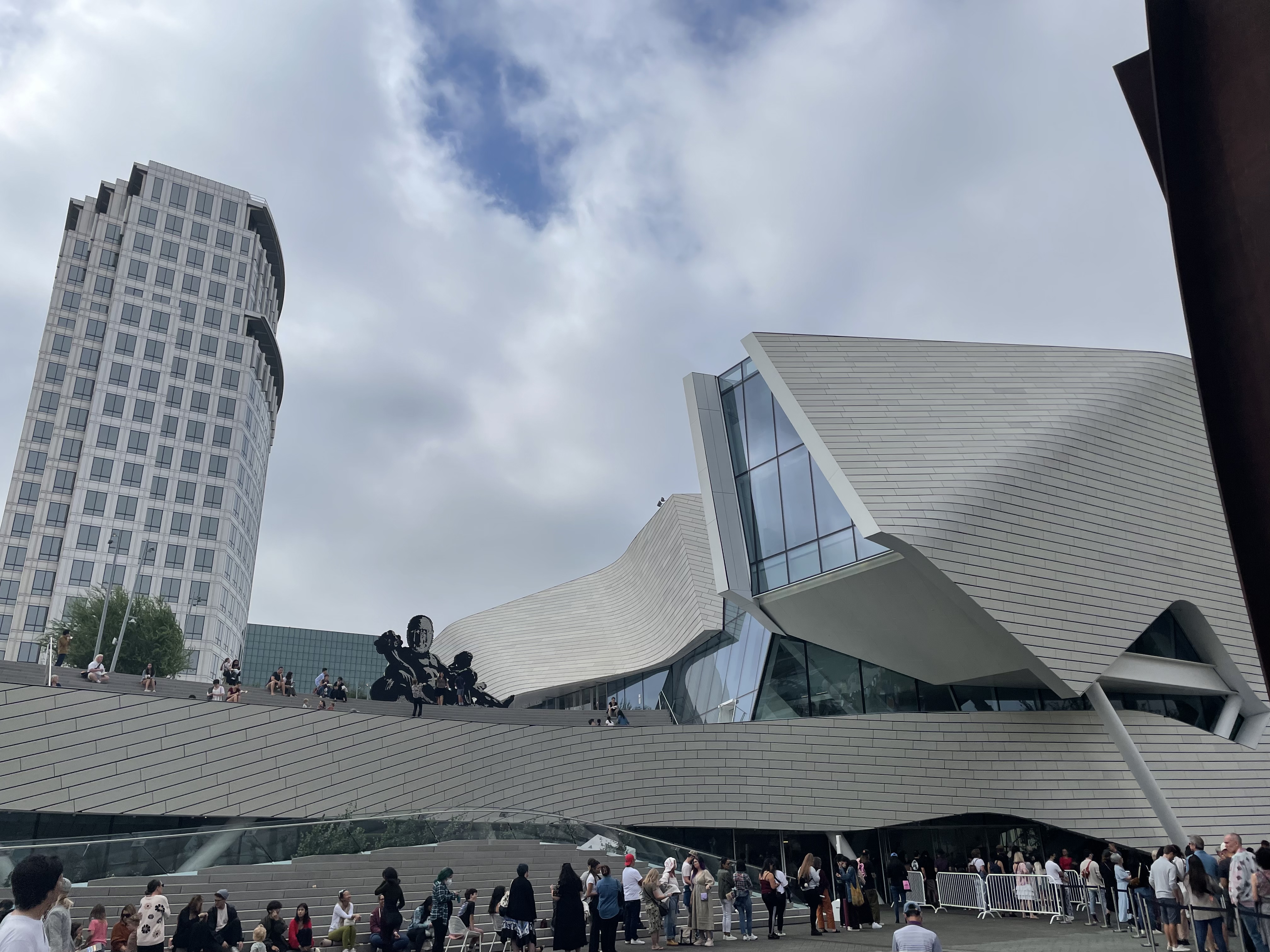
The second edition, Building As Ever, was curated in 2017 by Cassandra Coblentz, then OCMA's senior curator. The edition's organising figure (building as ever, as in the gerund of a continuing activity rather than a finished structure) took architecture and the architectural document as its central concern, against the institutional backdrop of OCMA's then-imminent relocation from its Newport Beach premises to a new building at the Segerstrom Center for the Arts in Costa Mesa, twelve miles north. The Costa Mesa building was designed by Thom Mayne of the Los Angeles firm Morphosis (Mayne is the recipient of the Pritzker Prize for 2005) and opened to the public on 8 October 2022, on the occasion of OCMA's fiftieth anniversary, after a long gestation across the institution's interim closures and pre-opening programmes. The 2022 reopening exhibition, however, was not a third California-Pacific Triennial: OCMA chose to revert to the California Biennial format under the title California Biennial 2022: Pacific Gold, co-organised by Elizabeth Armstrong, Essence Harden and Gilbert Vicario, with a further California Biennial (Desperate, Scared, But Social) following in 2025. No further California-Pacific Triennial has been announced since 2017; the museum’s recent surveys have run under the California Biennial title.
The institutional question the triennial has continued to pose across its two editions held, and that the announced 2026 edition will be asked to renew, is whether the regional museum of an American suburban metropolitan area (Orange County is the third-largest county in California by population, and lies between the Los Angeles institutional centre and the San Diego–Tijuana cross-border axis) can sustain a working international biennial against the gravitational pull of the Los Angeles County Museum of Art, the Museum of Contemporary Art Los Angeles, the Hammer Museum's Made in L.A. biennial, the Getty's Pacific Standard Time initiatives and the wider Los Angeles art-fair and gallery economy. The bet OCMA placed in 2013 was that a Pacific Rim curatorial framing, geographically and conceptually outside the city of Los Angeles, could carve out a distinct institutional position. The Mayne building, opening on the 2022 fiftieth anniversary, was the architectural confirmation of that bet, even as the institution paused the triennial title for two cycles before re-committing to it for 2026.