Most biennials are temporary exhibitions. The Folkestone Triennial's structural innovation is that it isn't: its commissioning budget produces permanent works that remain in the town between editions, accumulating across sixteen years into one of the most institutionally consequential public-art collections in postwar Europe.
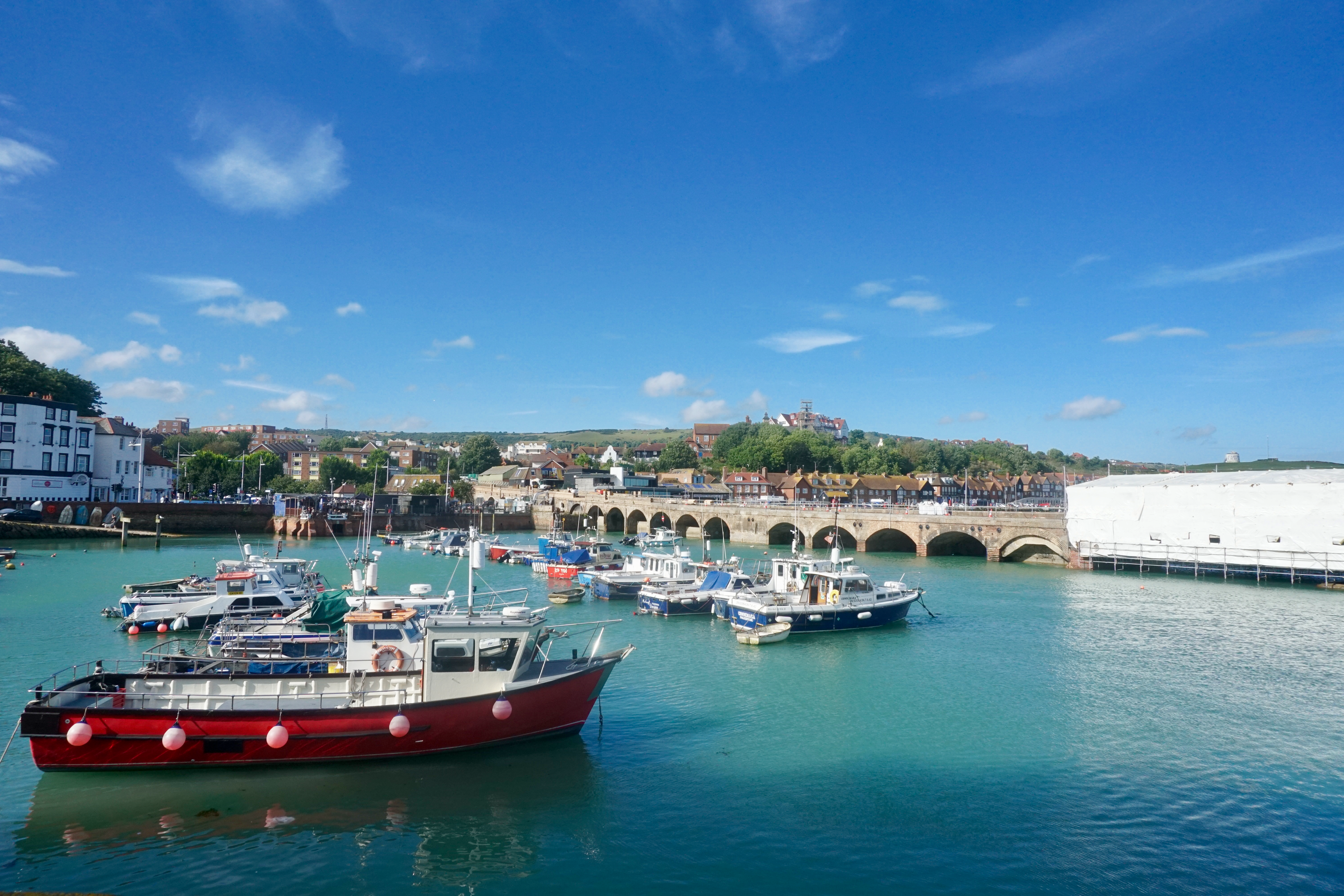
The Folkestone Triennial was founded in 2008 by Creative Folkestone, the charitable trust established 2002 by Sir Roger De Haan after he sold the Folkestone-based Saga Group (the Folkestone travel and insurance company founded by his father in 1951 and expanded under his directorship). De Haan's institutional argument, developed across the 2002–2008 period of Creative Folkestone's continuing pre-triennial activity, was that the post-industrial decline of the Folkestone coastal economy required a cultural-economic response at the institutional scale that municipal cultural policy could not produce. Folkestone had been one of the Edwardian English seaside resorts; the post-1970s collapse of the British seaside-tourism economy, the 1994 opening of the Channel Tunnel (which eliminated the ferry traffic that had been Folkestone's continuing economic anchor), and the post-1990 deindustrialisation of the Kent coastal economy had compounded into a continuing local economic crisis. De Haan's Creative Foundation purchased portions of the historic Old High Street and Tontine Street properties at private expense, restored them, and made them available to creative tenants at below-market rents, constituting the Folkestone Creative Quarter, the institutional architecture within which the triennial could subsequently operate.
The 1st Folkestone Triennial opened June 2008 under curator Andrea Schlieker (the German-British curator, previously Deputy Director of the Serpentine Gallery and at the ICA, London) under the title Tales of Time and Space. The 1st edition established the institutional model that has continued across six subsequent editions: a commissioned programme of new public works, a proportion of which would be acquired by Creative Folkestone and remain permanently installed in the Folkestone public space after the temporary triennial period closed. The founding tranche of permanent works included Mark Wallinger's Folk Stones (2008, a paved memorial to the Folkestone World War One soldiers who departed for the Western Front from the Folkestone Harbour); Tracey Emin's Baby Things (2008, a series of bronze sculptures of cast-off baby clothing distributed across the town addressing Folkestone teenage-pregnancy statistics that were among the highest in England in the period); Cornelia Parker's Folkestone Harbour work; and works by other artists who would anchor the Folkestone Artworks collection across the subsequent sixteen years.
The Schlieker-period 2nd Folkestone Triennial (2011) extended the founding institutional argument. The Lewis Biggs period across the 3rd (2014, Lookout) and 4th (2017, double edge) editions extended the permanent-works tranche with commissioned permanent works including major commissions on the Harbour Arm and Sunny Sands that have since anchored the Folkestone Artworks collection, alongside works by Antony Gormley, A.K. Dolven, Patrick Tuttofuoco, Bill Woodrow, and Pablo Bronstein. Biggs was Director of Tate Liverpool (1990–2000) and founding Artistic Director/Chief Executive of the Liverpool Biennial (2000–2011, co-founded 1998 with James Moores): the institutional architect of two of the UK biennial-form institutional projects of the post-1990 period. His Folkestone period extended the institutional rigour that the founding Schlieker period had established.
The 5th Folkestone Triennial (2021, postponed from 2020 by Covid-19) was the last under outgoing curatorial leadership; Sorcha Carey, previously Director of the Edinburgh Art Festival, then took on the curator's role for the 6th Triennial (How Lies the Land?, 19 July – 19 October 2025), her first edition. The 6th edition extended the Folkestone Artworks collection across new commission sites including inland Folkestone neighbourhoods that the earlier editions had not activated, working with a deep-time and ecological thematic register and presenting eighteen new commissions by artists from over fifteen countries.
The Folkestone Artworks collection (the accumulated permanent works across six triennials) now exceeds seventy continuing public works distributed across the town, free to encounter, with a published walking guide and the Creative Folkestone year-round operational programme that maintains the collection between editions. The collection is institutionally singular within the international biennial form: few biennials produce permanent works at scale, and none has accumulated a continuing public-art collection of comparable institutional consequence across a comparable timeframe. The Folkestone permanent collection is the institutional record on which the Folkestone Triennial's continuing institutional reading turns.
The 7th Folkestone Triennial is planned for 2028, 20 years after the first edition. The continuing institutional question is whether the De Haan-funded Creative Folkestone institutional architecture can sustain the commissioning model across generational transitions of the founding philanthropic generation. De Haan is 76 in 2025; continuing philanthropic commitment from the De Haan family across subsequent generations is the structural condition on which the Folkestone Triennial's continuing institutional architecture depends.
The institutional architecture
The Folkestone Triennial is organised by Creative Folkestone, the Folkestone-based charitable trust established 2002 by Sir Roger De Haan. Continuing institutional support comes from the De Haan family philanthropic commitments, Arts Council England (as continuing National Portfolio Organisation), the Folkestone and Hythe District Council, and the Kent County Council. The Creative Folkestone year-round operational programme maintains the Folkestone Artworks collection between triennial periods and anchors the continuing Folkestone Creative Quarter cultural infrastructure.