Momentum is the Nordic Biennial of Contemporary Art, founded in 1998 in Moss — a small post-industrial city of some 50,000 on the eastern shore of the Oslofjord, an hour south of Oslo by train — by the Danish critic Lars Bang Larsen, the Swedish critic Daniel Birnbaum (then editor of Material, later rector of the Royal Institute of Art in Stockholm and director of the Moderna Museet) and the Norwegian gallerist Atle Gerhardsen, on a commission from the Moss municipality and the local cultural-policy ecosystem that had grown around Galleri F 15, the contemporary-art space at Alby gård on Jeløya. The inaugural edition, titled Pakkhus (warehouse) after the converted dock building that served as its main site, opened in the summer of 1998 and was the first major attempt — among any of the Nordic countries — to constitute the Nordic region as a single curatorial address through a recurring exhibition. The conceptual moment that made it possible was the so-called Nordic miracle of the late 1990s, the cultural-political fiction by which the five Nordic countries (Denmark, Finland, Iceland, Norway, Sweden) were seen, from outside the region, as a shared cultural unit producing a disproportionate share of contemporary art and design within Europe.
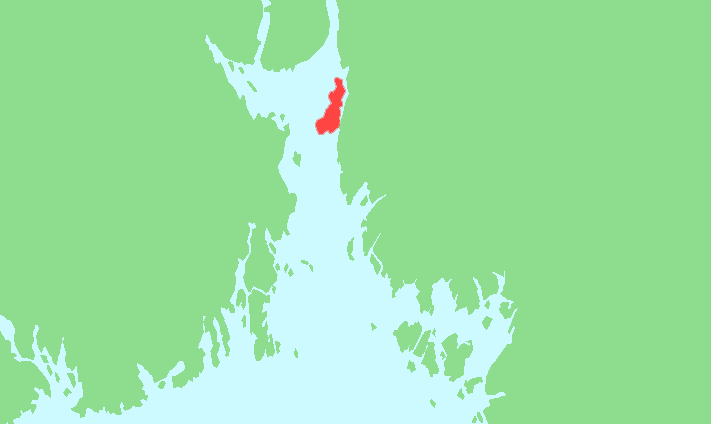
The 13th edition, Between/Worlds: Resonant Ecologies, opened on 14 June 2025 and closed on 12 October under the curatorship of Morten Søndergaard, Danish sound-art scholar and professor of sound and media art at Aalborg University. Søndergaard organised the edition around sound — sound as the medium through which the relation between human and non-human worlds becomes audible, sound as the discipline that troubles the dominance of the optic in contemporary art, sound as a material capable of registering the volcanic, glacial and forest histories of the eastern Oslofjord. The exhibition was distributed across five zones rather than venues: the post-industrial city of Moss, the forests around the Alby manor, the Oslofjord itself, the volcanic island of Jeløy, and the historic nineteenth-century buildings of Galleri F 15 at Alby gård. The format — approximately forty site-specific projects, with no single principal hall — was conceived as the institution's working answer to its long-standing structural question: how a Nordic regional biennale in a town of 50,000 sustains a programme through site, fieldwork and duration rather than through international-circuit spectacle.
An institution rebuilt out of a manor and a brewery
The structural feature that distinguishes Momentum from the older Venice Biennial (founded 1895) and from the urban-spectacle biennials of São Paulo, Berlin and Istanbul is the modesty and specificity of its institutional infrastructure. The principal site is not a national pavilion, a former industrial hall or a converted exhibition centre — it is a working contemporary-art gallery, Galleri F 15, founded by the collector Lars Brandstrup in 1966 at the address Fossen 15 in Moss and moved to the Alby manor on Jeløya in 1967 after the municipality bought the property and offered the gallery the building. The manor itself, an Empire-style structure raised in plastered brick in the 1870s on a site whose record reaches back to 1389, is the senior cultural-historical layer beneath the biennale; the gallery, founded in the international wave of regional kunsthalle openings of the long 1960s, is the institutional layer; and the biennale, established in 1998 and merged into Galleri F 15 in 2006 (when the combined institution was for a time renamed Punkt Ø, before the name reverted to Galleri F 15 in 2019), is the third and most recent layer. The second site, the Momentum Kunsthall — a converted brewery in central Moss — has been a continuing companion venue across multiple editions.
The biennale's history breaks into three phases. The first phase, 1998 to 2009, was the period of the founding model — Bang Larsen, Birnbaum and Gerhardsen's Pakkhus (1998) followed by Ina Blom, Jonas Ekeberg, Jacob Fabricius and Paula Toppila's Park (2000), Caroline Corbetta and Per Gunnar Tverbakk's edition of 2004, Annette Kierulf and Mark Sladen's Try Again. Fail Better. (2006) and Lina Džuverović and Stina Högkvist's Favoured Nations (2009) — across which the model of curatorial teams (typically two to four curators from the five Nordic countries plus an international guest) was established and the Nordic-regional framing tested and refined. The second phase, 2011 to 2019, was the period of the pan-Nordic curatorial collective: Imagine Being Here Now (2011) curated by Markús Þór Andrésson (Iceland), Theodor Ringborg (Sweden), Aura Seikkula (Finland), Christian Skovbjerg Jensen (Denmark) and Marianne Zamecznik (Norway) made the five-country curatorial team explicit and structural; Tunnel Vision (2015), Alienation (2017) and The Emotional Exhibition (2019) extended the model. The third phase, from 2021 onward, has been the period of restructuring — the controversy of House of Commons (2021), the methodological experiment of Together as to Gather (2023) curated by the artist collective Tenthaus, and the disciplinary reorientation of Between/Worlds (2025) around sound. The current question, on the eve of the 14th edition, is what the next phase will be.