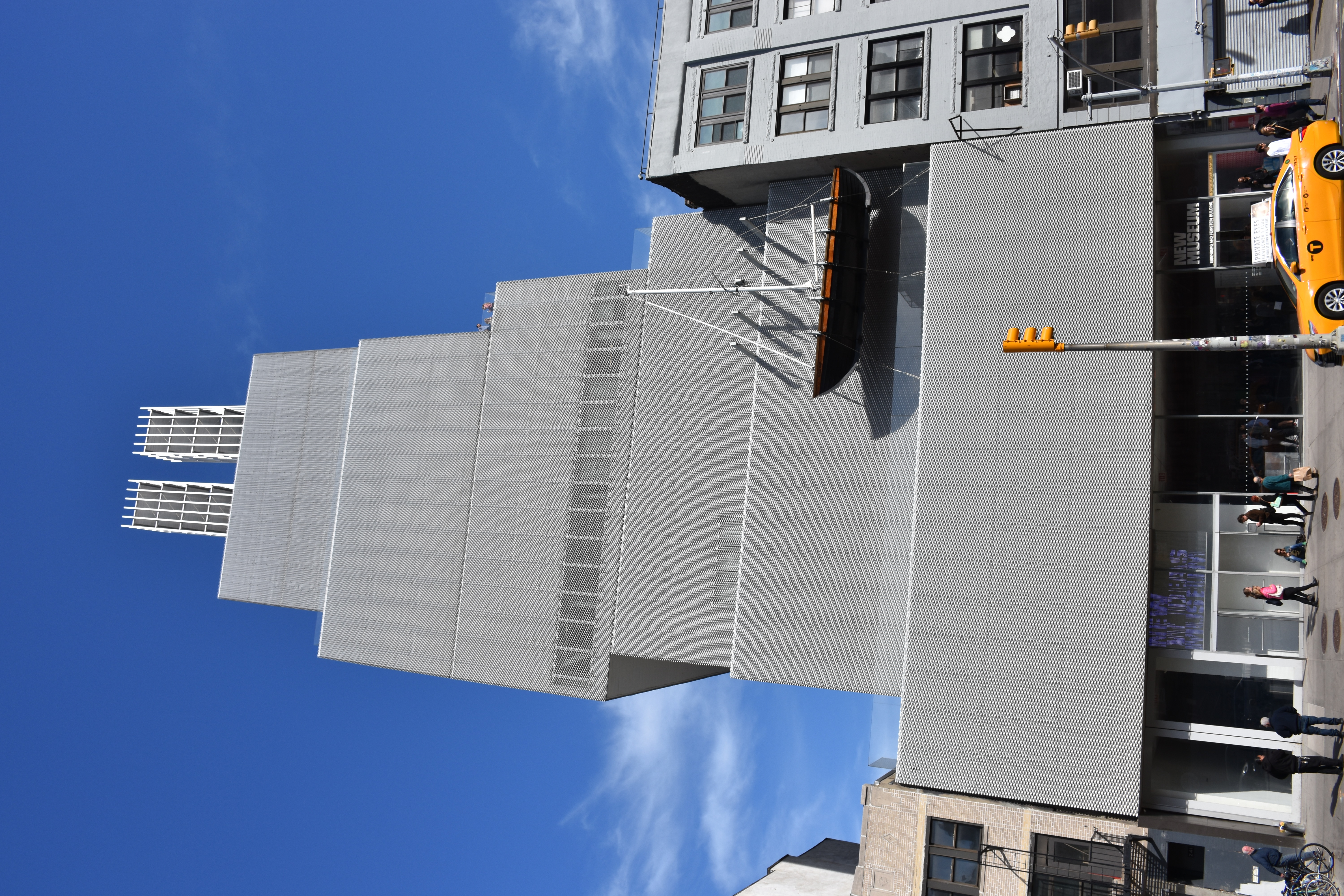
When the first New Museum Triennial opened in April 2009, only sixteen months after the SANAA building had been unveiled on the Bowery, the institutional argument was unusually specific: that a museum should commit, on a recurring three-year cadence, to exhibiting fifty artists at the beginning of their work — and that this commitment could carry the weight of a museum's serious curatorial position.
The 1st New Museum Triennial, titled Younger Than Jesus, opened on 8 April 2009 and closed on 5 July 2009 — sixteen months after the SANAA building on the Bowery had opened, sixteen years into Lisa Phillips's directorship of the New Museum, and at the precise moment when the institutional question of what the relaunched New Museum was for had become acute. The founding edition presented fifty artists, all born after 1976, drawn from twenty-five countries and selected by the curatorial trio of Lauren Cornell, Massimiliano Gioni, and Laura Hoptman — three of the more institutionally consequential curatorial figures of the post-2000 American contemporary art conversation. The title was deliberately provocative; the editorial premise was not. The Triennial would commit, on a three-year cadence, to artists in their twenties and early thirties, would draw from outside the European and North American axis, and would treat the under-thirty-five generation as a serious curatorial subject rather than as a forecast or a market signal.
The institutional context for that argument was specific. The New Museum had been founded in 1977 by Marcia Tucker — recently dismissed from the Whitney Museum of American Art — as the New York institutional answer to the question of what a contemporary art museum could do that the Whitney, MoMA, and the Guggenheim were structurally not doing. The Tucker New Museum operated for its first quarter-century as an institutionally serious and physically modest organisation, moving across SoHo lofts and working on a curatorial premise that prioritised living artists, women artists, and artists of colour whose work the larger New York institutions were not exhibiting. Lisa Phillips, formerly a curator at the Whitney, assumed the directorship in 1999, and across the following decade led the institutional expansion — culminating in the SANAA building, opened 1 December 2007, the first museum from the ground up in lower Manhattan in a century, and the institutional emblem of the post-Tucker New Museum's new ambitions. The 2009 Triennial was the curatorial form built to answer the question of what those ambitions, in the new building, were for.
The founding curatorial trio mattered. Massimiliano Gioni — Italian curator, then the New Museum's Director of Special Exhibitions, later Artistic Director and curator of the 55th Venice Biennale (The Encyclopedic Palace, 2013) — brought to the Triennial the international curatorial network he had built across the Fondazione Trussardi in Milan and the Manifesta circuit. Laura Hoptman, then a senior curator at the New Museum, had previously curated the 2004 Carnegie International and would later move to MoMA. Lauren Cornell, then Executive Director of Rhizome and adjunct curator at the New Museum, and subsequently the New Museum's curator and Associate Director, brought the internet-and-net-art conversation that would shape the Triennial's continuing register through 2015. The combination produced an edition that read the under-thirty-five generation as international and engaged with the conditions of digital, post-internet, and post-recession contemporary work — and that read it three years before the post-internet conversation became a curatorial commonplace.
The 2nd Triennial (The Ungovernables, 12 February – 22 April 2012), curated by Eungie Joo — then Director and Curator of Education and Public Engagement at the New Museum, later Curator of Contemporary Art at the San Francisco Museum of Modern Art — extended the founding argument in a sharper political register. Joo's edition presented thirty-four artists and collectives from twenty countries, with representation from Latin America, Africa, the Middle East, and South and Southeast Asia, and operated against the post-2011 political backdrop of the Arab uprisings, Occupy, and the global protest year of 2011. The 3rd Triennial (Surround Audience, 25 February – 24 May 2015), co-curated by Lauren Cornell and artist Ryan Trecartin, returned the conversation to the digital and the post-internet — fifty-one artists, an exhibition organised around the question of what living inside continuous online attention had done to artistic practice, and now widely cited as the institutional inflection point at which the post-internet conversation entered the mainstream American museum.
The 4th Triennial (Songs for Sabotage, 13 February – 27 May 2018), curated by Gary Carrion-Murayari and Alex Gartenfeld, presented twenty-six artists working in a sculptural and installational register against the political backdrop of the first Trump year — the title acknowledged the protest-art conversation that had reorganised the New York gallery scene across 2017 — and operated as a more focused curatorial premise than the preceding three editions. The 5th Triennial (Soft Water Hard Stone, 28 October 2021 – 23 January 2022), curated by Margot Norton and Jamillah James, had been originally scheduled for 2020 and was postponed by the Covid-19 pandemic; the edition presented forty artists working through questions of erosion, resilience, and the slow remaking of structures, and was read as the institutional response to the conditions of the pandemic year. The 6th Triennial, organised by Vivian Crockett (New Museum) and Isabella Rjeille (MASP, São Paulo) — the first international curator to organise the Triennial — is scheduled for 2026, the first edition to be held in the OMA-designed extension.
What the five editions to date have built is the principal continuing American institutional argument for emerging artists as a serious curatorial subject. The Whitney Biennial, founded 1932 and reorganised on a biennial cadence in 1973, remains the principal American national survey — its institutional commitment is to artists working in the United States, across generations, with a centre of gravity in the mid-career. The New Museum Triennial occupies a structurally different position: international rather than national, generational rather than mid-career, and committed to artists whose work the institutional museum field has not yet absorbed. That position is now an established part of the American institutional landscape, and the Triennial's continuing capacity to occupy it — across the post-Covid period, under continuing Lisa Phillips leadership, and in relation to the post-2007 New Museum institutional expansion — is the principal continuing question.
The institutional architecture
The New Museum Triennial is organised by the New Museum, an independent non-collecting contemporary art museum founded 1977 by Marcia Tucker, with current address at 235 Bowery, Manhattan, in the seven-storey SANAA-designed building opened December 2007. The museum is led by Lisa Phillips as Toby Devan Lewis Director (since 1999), with a curatorial department under Massimiliano Gioni's Artistic Directorship across the post-2010 period. Each Triennial is curated by an appointed team — typically two curators drawn from the New Museum's own staff or from invited external curators — and presented across the SANAA building's gallery floors. The institutional expansion currently underway includes the OMA-designed New Museum addition at 231 Bowery, which when completed will double the museum's gallery space and is expected to expand the scale of the Triennial accordingly.