The Rauma Biennale Balticum

Finland's biennial of contemporary art of the Baltic Sea region, founded in 1977 in the small Satakunta port of Rauma as the Gulf of Bothnia Biennial assembling artists of the Finnish and Swedish coasts, and renamed the Rauma Biennale Balticum in 1985 to take in the whole Baltic littoral. The biennale ran at the Rauma Art Museum from 1977 to 2016; in 2019 the institution transitioned to a triennial format as the Rauma Triennale. The third Triennale, Lumoava vaiva / Enchanting Effort, curated by Sanna Karimäki-Nuutinen, runs from 7 June to 21 September 2025 at the Pinnala House in UNESCO-listed Old Rauma and at the Muijala Art Space in nearby Reila.

Established1977 — 2025three Triennale editions
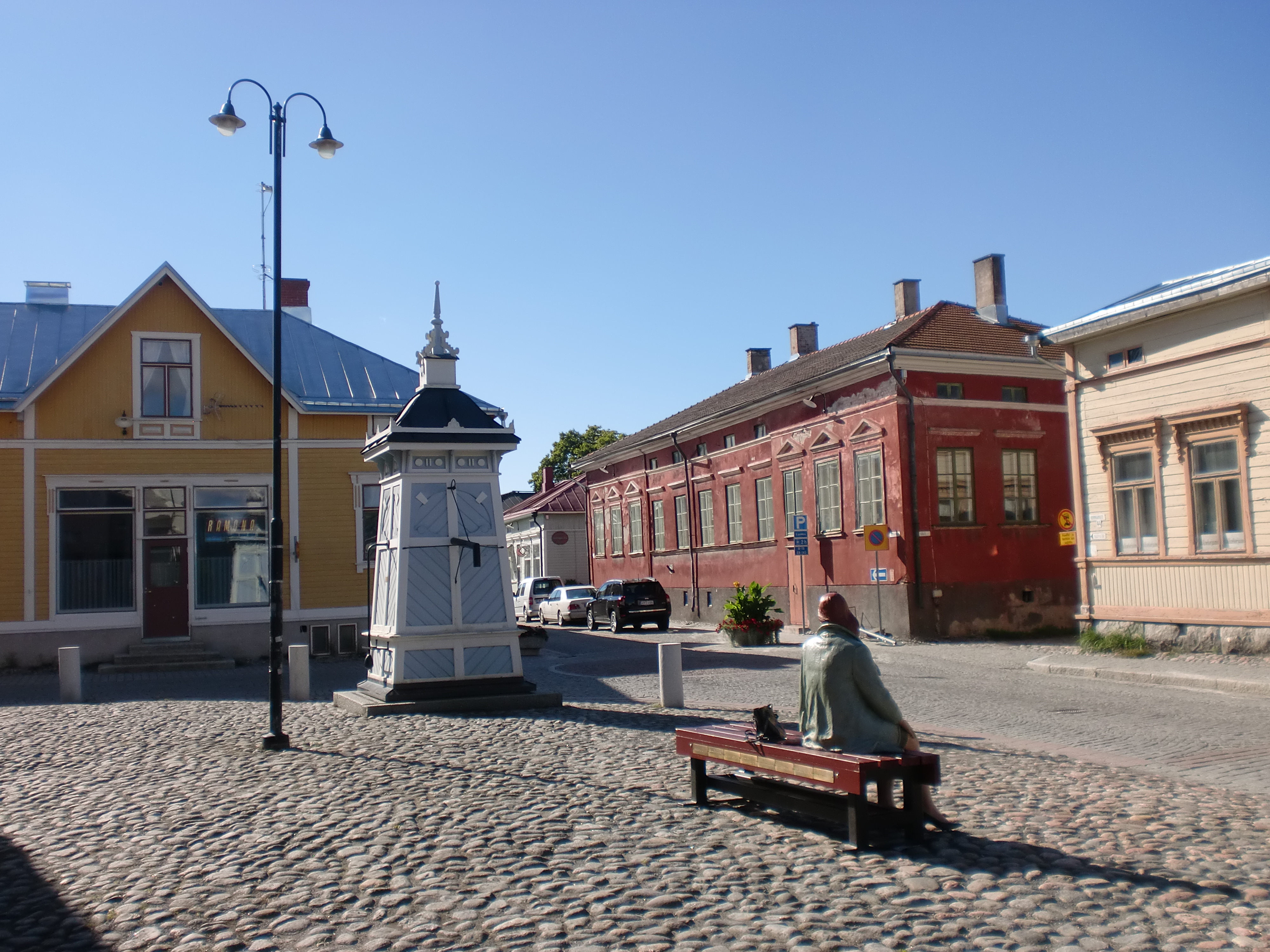
The wooden Old Town of Rauma (Vanha Rauma) — a UNESCO World Heritage site since 1991 and the largest preserved wooden town area in the Nordic countries — the urban setting of the Rauma Biennale Balticum and the Rauma Triennale.
Above The UNESCO-listed wooden Old Town of Rauma, inscribed in 1991 as a unique surviving example of a living and well-maintained Nordic wooden town. The pink Pinnala House (1795) on Kuninkaankatu, the first private stone building in Rauma, has housed the Rauma Art Museum since 1970 and has been the continuing home of the Rauma Biennale Balticum since 1985 and of the Rauma Triennale since 2019.

The Lead Essay The third Rauma Triennale

Karimäki-Nuutinen's Enchanting Effort

The third Rauma Triennale, Lumoava vaiva / Enchanting Effort, runs from 7 June to 21 September 2025 under the curatorship of Sanna Karimäki-Nuutinen, head curator of the Seinäjoki Art Hall and a doctoral researcher whose practice centres on disability, accessibility and the Finnish concept of vaiva — effort, trouble, taking-the-trouble — as a productive cultural value. Thirteen artists and artist collectives across Finland, Estonia, Sweden and Germany work the theme at the Pinnala House in Old Rauma and at the Muijala Art Space in nearby Reila, where co-curators Roos Hermsen and Serhii Varlamov hold a parallel programme.

The Rauma Biennale Balticum is the senior continuing contemporary-art biennale of the Baltic Sea region and, after the São Paulo and Venice traditions, one of the older surviving postwar biennales of Europe's smaller cities. Its origin is older than its present name suggests: the serial of exhibitions began at the Rauma Art Museum in 1977 as the Gulf of Bothnia Biennial, an assembly of artists from the coastal towns and cities of Finland and Sweden, working the narrow water — the Pohjanlahti — that separates the two countries. In 1985 the exhibition was opened out to all the Baltic littoral states — Finland, Sweden, Denmark, Germany, Poland, the three Soviet-era Baltic republics of Estonia, Latvia and Lithuania, and the Russian and Norwegian coasts — and renamed the Rauma Biennale Balticum. From that moment on, and in particular from the close of the Cold War onward, the biennale held an institutional position that no other European programme held in the same form: a continuing biennial of contemporary art assembled around a single shared sea, programming artists from countries whose political relationships across that sea were continually being remade.

The institutional argument the biennale made — and which the 2025 Triennale, under Sanna Karimäki-Nuutinen, continues to make — is that the Baltic Sea is a cultural and ecological unit. The early Rauma curator Timo Keinänen, looking back on the programme he had helped to inaugurate, put the argument plainly: "We were building cultural bridges at a time when political ones seemed impossible." The biennale's continuing emphasis, across the four decades since 1985, has been on ecological and environmental concerns (the pollution of the Baltic, the fisheries, the coastline, the climate of the north), on the daily lives of the region's communities, and on the institutional work of curatorial exchange across borders that political institutions could not always cross. The 2025 Triennale, with its insistence on vaiva — on the value of effort, on disability and accessibility as positions from which to think contemporary art rather than as items on a compliance checklist — extends that argument into the institutional question of who the biennale form is for.

The chief-curatorial era and the move to triennial

From 1990 onwards the biennale was structured around invited guest curators or in-house curatorial teams, and from 2002 a single chief-curatorial team — museum director Janne Koski and curator Henna Paunu — held continuing responsibility for the programme. The Koski–Paunu period across the 2000s and 2010s — Talking to me? (2004) on broken communication, Wake up! (2006), Flower Power (2008), What's up, Sea? (2010), Ihmisluonto / Human Nature (2012), Crime Scene (2014) on activism and ethics, and the closing 2016 edition — consolidated the biennale's reputation as one of the most consistent regional programmes in northern Europe, with a continuing high-quality catalogue and a continuing position in the Ars Baltica cultural network of the Baltic Sea region. The 2016 edition was the final one under the Biennale Balticum name. After a hiatus of three years, the museum relaunched the programme in 2019 as the Rauma Triennale, with a new triennial rhythm. The first Triennale, In Praise of Boredom, opened 8 June 2019 and ran through 15 September; the second, Imagine! Mitä jos! / Imagine! What if!, was curated by chief curator Heta Kaisto and artist Teemu Mäki and opened on 11 June 2022, running through 25 September; the third, Lumoava vaiva, opens in summer 2025 under Karimäki-Nuutinen.

The structural feature of the institution that no other Baltic Sea contemporary art programme matches is the venue itself. The Rauma Art Museum is housed in the pink Pinnala House on Kuninkaankatu, the central street of Old Rauma — a wooden urban fabric of approximately six hundred buildings, mostly privately owned and inhabited, on a street network that descends from the medieval ground plan and that was inscribed on the UNESCO World Heritage List in 1991 as the largest surviving wooden town area in the Nordic countries. The Pinnala main building dates from 1795 and is the first private stone house in Rauma; the museum has occupied it since 1970. The argument the Rauma programme has continued to make — that contemporary art of the Baltic Sea region is worth assembling and reading inside a working eighteenth-century Nordic urban fabric, rather than in the white-cube spaces of Helsinki, Stockholm or Berlin — is the structural argument the institution makes that no other Baltic Sea contemporary art biennale makes in the same form.
Critical Perspective Heritage and the regional biennale

The argument from Old Rauma

The Baltic Triennial in Vilnius (1979) is older. The Helsinki Photo Biennial is bigger. The Setouchi Triennale's heritage-site argument is grander. The Rauma programme makes its case along a narrower seam: a continuing biennial of Baltic Sea contemporary art at the Rauma Art Museum's eighteenth-century Pinnala House, inside the largest preserved wooden town in the Nordic countries — a UNESCO World Heritage site since 1991 — programmed not against the heritage fabric but inside the life of it.

The contemporary biennale field has, across the past two decades, gravitated toward two structural arguments about venue. The first is the global-city argument, in which a biennale — Venice, São Paulo, Sharjah, Sydney, Gwangju — anchors a network of pavilions or principal venues across a working metropolis whose civic infrastructure can absorb the institutional weight of an international event. The second is the heritage-site argument, in which a biennale — the Setouchi Triennale across the Inland Sea islands of Japan, the Echigo-Tsumari Art Triennale across the satoyama villages of Niigata, Skulptur Projekte Münster's incursions into a German university town — installs contemporary work into rural or heritage environments whose existing fabric becomes the principal interlocutor of the new commissions. The Baltic Sea region's biennale field is small and uneven, but it has both arguments at work in it. The Baltic Triennial at the Contemporary Art Centre in Vilnius, founded in 1979 and the senior continuing programme of the Lithuanian institution, sits at the global-city end of the field; the Rauma Biennale Balticum sits at the heritage-site end.

The case Rauma makes is the case for the second argument operating not at the scale of an entire region — the Echigo-Tsumari and Setouchi argument — but at the scale of a single small town. Old Rauma is approximately twenty-nine hectares; it carries about six hundred buildings, eight hundred residents and a continuous medieval street pattern that survived the 1682 city fire and was rebuilt in timber across the following century. The Rauma Art Museum's Pinnala House is one of the older surviving buildings of that rebuild and is one of the principal sites of the UNESCO-inscribed area. The argument the biennale makes is that the small-town heritage venue is not a constraint on contemporary practice but a working pressure on it: the institution's catalogue history — across What's up, Sea? (2010), Human Nature (2012), Crime Scene (2014) and the rest — is a sequence of attempts to programme contemporary Baltic Sea work into a building and a town that pre-date the contemporary by two and a half centuries.

The Latvian critic Alise Tifentale, reviewing the 2010 biennale in the Riga journal Studija, put the dialectic of the argument with appropriate dryness. "Rauma cannot be visited on the way; you have to plan a visit there", she wrote; "only in this remote place, as seen from the egocentric point of view of Western Europe, in the quiet and peacefulness of the seaside provincial town, our art is really at home." Tifentale's 2010 review was not uncritical of the curatorial direction under Janne Koski — she suspected, of the What's up, Sea? tagline, that the ideas may have dried up — but the structural observation about the venue is the institution's continuing argument: that a contemporary biennale of the Baltic Sea programmed inside the largest surviving Nordic wooden town does work that the white-cube spaces of the larger Baltic capitals cannot do. The 2019 transition to a triennial format and the 2025 edition's commitment to accessibility — including the installation of a new ground-floor lift in the 200-year-old Pinnala building in spring 2025 — is the institution's working answer to the question of whether the heritage-site argument can be sustained in the second half of the twentieth century's hundred years.

The Rauma programme's continuing position, across the 2025 Triennale and onward, is the curatorial bet that the Baltic Sea region's contemporary art conversation needs at least one institutional space whose dimensions are not those of a metropolitan kunsthalle but those of a pink, two-and-a-half-storey, late-eighteenth-century stone-and-timber house on a wooden street. The 2025 commitment to vaiva — to disability, to slow working, to the value of taking-the-trouble — reads as the curatorial extension of the venue's own historical condition into the programme's working subject.


The Institutional Spine

Defining moments

Five episodes from nearly five decades of the Rauma programme.

1977Foundation

The Gulf of Bothnia Biennial founding

The serial of exhibitions began in 1977 at the Rauma Art Museum as the Gulf of Bothnia Biennial, assembling artists from the coastal towns and cities of Finland and Sweden across the Pohjanlahti — the narrow body of water that separates the two countries. In the early years, artists' associations and cultural offices of the participating coastal cities were invited to propose artists for the exhibition; the programme operated as a network exhibition rather than as a single-curator biennial. The founding argument — that the Gulf of Bothnia constituted a working cultural unit — was the geographic kernel from which the wider Baltic Sea argument would be developed in 1985.

Sources: Biennial Foundation; Rauma Art Museum

1985Rename

The expansion to Rauma Biennale Balticum

In 1985 the exhibition was opened out from the Gulf of Bothnia to the full Baltic Sea region — Finland, Sweden, Denmark, Germany, Poland, Estonia, Latvia, Lithuania, Russia and Norway — and renamed the Rauma Biennale Balticum. From 1990 onward, with the political reordering of the eastern Baltic after the close of the Cold War, the biennale was reorganised around invited guest curators or curatorial teams with thematic responsibility, and the catalogue — designed each edition by an invited graphic designer — became part of the programme's continuing institutional record. The biennale's place in the Ars Baltica cultural network of the Baltic Sea region was consolidated in this period.

Sources: Biennial Foundation; Rauma Art Museum

1994Curator

Helēna Demakova's Midsummer Night's Dream

The 1994 edition was curated by the Latvian critic Helēna Demakova — later Minister of Culture of Latvia from 2004 to 2009 — under the title Sapnis vasaras naktī / Midsummer Night's Dream. Demakova's wider curatorial argument across her Rauma involvement was that the biennale's role was to assemble work from across the Baltic Sea region in a setting whose distance from the Western European cultural Grand Tour allowed an unusual atmosphere to emerge — "such a widely varied collection of images removed from their creators tends to produce an unusual atmosphere", as she put it. The 1994 edition is the institutional moment at which the curatorial argument for Rauma as a small-town Baltic Sea biennale was put on its longest-running formulation.

Sources: Tifentale, Studija 75; Wikipedia — Demakova

2014Crime Scene

Koski and Paunu's Crime Scene

The 2014 Rauma Biennale Balticum, Crime Scene, was co-curated by chief curator and museum director Janne Koski and assistant curator Henna Paunu — the continuing chief-curatorial team since 2002 — and presented contemporary art projects addressing crime and punishment, activism, ethics and social justice across the Baltic Sea region. The edition was the institutional high point of the long Koski–Paunu chief-curatorial era, which extended from 2002 through the closing 2016 edition and which made the visual identity of the biennale, designed each edition by an invited graphic designer, into a continuing component of the programme.

Sources: Biennial Foundation, 2014; Academia — Visual identity case study

2019Triennale

The transition to the Rauma Triennale

After the 2016 edition closed the long Biennale Balticum sequence, the Rauma Art Museum relaunched the programme in summer 2019 on a triennial rhythm as the Rauma Triennale. The inaugural Triennale, In Praise of Boredom, ran from 8 June to 15 September 2019 and argued for the value of boredom as a position from which to think the stimulus-saturated condition of the digital era. The Triennale is organised by the Rauma Art Museum with the support of the Jenny and Antti Wihuri Foundation, the City of Rauma and the Arts Promotion Centre Finland; the second edition (Imagine! What If!, 2022, curated by Heta Kaisto and Teemu Mäki) and the third (Enchanting Effort, 2025, Karimäki-Nuutinen) have established the new format.

Sources: Biennial Foundation, 2019; Rauma Triennale 2022

People in the Rauma programme

The figures behind Rauma

Curator · 2025 Triennale

Sanna Karimäki-Nuutinen

Finnish curator and doctoral researcher; head curator of the Seinäjoki Art Hall (Seinäjoen taidehalli) from 2010 to 2024. Curator of the 2025 Rauma Triennale, Lumoava vaiva / Enchanting Effort, which centres the Finnish concept of vaiva — effort, trouble, taking-the-trouble — as a productive cultural value, and which programmes thirteen artists and artist collectives across Finland, Estonia, Sweden and Germany. Her personal experience as the mother of a daughter with disabilities informs the edition's curatorial commitment to disability, accessibility and neurodivergence as positions from which to think contemporary practice.

Source: Rauma Art Museum, Triennale 2025; Visit Rauma, 2025

Chief Curator · 2002 – 2016 · Museum Director

Janne Koski

Finnish museum director and curator; director of the Rauma Art Museum and chief curator of the Rauma Biennale Balticum continuously across the 2002 – 2016 chief-curatorial era, with assistant curator Henna Paunu — the longest single curatorial tenure in the institution's history. Editions under Koski's direction include Talking to Me? (2004), Wake up! (2006), Flower Power (2008), What's up, Sea? (2010), Human Nature (2012), Crime Scene (2014) and the closing 2016 edition. The Koski period consolidated the biennale's place in the Ars Baltica network and its institutional continuity through the period of European political reordering after 2004.

Source: Tifentale, Studija 75; LinkedIn — Janne Koski

Co-curator · 2002 – 2016

Henna Paunu

Finnish curator originally from Rauma; assistant curator (amanuenssi) and continuing co-curator of the Rauma Biennale Balticum across the Koski chief-curatorial era from 2002 through 2016. Co-curator with Janne Koski of Crime Scene (2014), Talking to me? and the wider sequence of editions across the 2000s and 2010s. Subsequently Chief Curator at EMMA — Espoo Museum of Modern Art, where she is responsible for the institution's contemporary collection programmes.

Source: City of Espoo, 2024; LinkedIn — Henna Paunu

Curator · 1994 Biennale Balticum

Helēna Demakova

Latvian art historian and curator; curator of the 1994 Rauma Biennale Balticum, Sapnis vasaras naktī / Midsummer Night's Dream. Began curating exhibitions in 1990 and has implemented approximately forty Latvian and international exhibitions, with a curatorial focus on the contemporary art of Latvia and the Baltic Sea region; Minister of Culture of Latvia from 2004 to 2009 and a Member of the Latvian Saeima. Her involvement with the Rauma programme — across the early 1990s and into the mid-decade — is one of the institutional connections that made the Latvian and the wider Baltic state contemporary art conversation visible in the Finnish programme in the years immediately after the restoration of the Baltic states' independence.

Source: Wikipedia — Helēna Demakova; Tifentale, Studija 75

Founded
1977 · Rauma
Original name
Gulf of Bothnia Biennial
Frequency
Triennial (from 2019)
Principal venue
Rauma Art Museum · Pinnala House
Organiser
Rauma Art Museum

Geography

The Rauma Biennale at the Pinnala House, Old Rauma

Principal venues

Rauma Art Museum — Pinnala House

The pink Pinnala main building, dating from 1795 and the first private stone house in Rauma, has been the Rauma Art Museum since 1970 and the continuing home of the Rauma Biennale Balticum since 1985 and of the Rauma Triennale since 2019. The museum sits inside the UNESCO World Heritage area of Old Rauma. A new ground-floor lift was installed in spring 2025 as part of the institution's accessibility programme.

Kuninkaankatu 37
Old Rauma, 26100
Rauma, Finland

Muijala Art Space (Taidetila Muijala)

International artist residency and art space in Reila, Pyhäranta, founded by the Dutch curator Roos Hermsen. From the 2025 Triennale onward, Muijala has been a second venue for the Rauma programme; co-curators Hermsen and Serhii Varlamov contribute the residency-linked section of the 2025 edition and the parallel summer exhibition Soft Fascination.

Soukontie 61
Reila, Pyhäranta
Finland

Old Rauma (Vanha Rauma) — UNESCO World Heritage area

The largest preserved wooden town area in the Nordic countries, inscribed on the UNESCO World Heritage List in 1991. Approximately 29 hectares; about 600 buildings on a street network descended from the medieval ground plan; about 800 residents. The post-1682-fire timber rebuild is the urban setting for the Rauma programme.

Old Rauma area
26100 Rauma
Finland

From the Directory

Related Baltic and Nordic biennials

Browse the region →

Essential Reading

For further work

Rauma Biennale Balticum 1994 — Sapnis vasaras naktī / Midsummer Night's Dream

Helēna Demakova, curator  ·  1994

Catalogue of the 1994 edition, curated by the Latvian critic Helēna Demakova — one of the post-Cold-War editions that consolidated the institution's Baltic Sea curatorial argument across the immediate years after the restoration of the Baltic states' independence.

Rauma Biennale Balticum 2008 — Flower Power

Janne Koski (ed.)  ·  Rauma Art Museum, 2008

Catalogue of one of the early Koski–Paunu chief-curatorial editions; held by university and museum libraries across Finland.

Rauma Biennale Balticum 2012 — Ihmisluonto / Human Nature

Laura Kokkonen et al.  ·  Rauma Art Museum, 2012

Catalogue of the 2012 edition on the institution's continuing ecological and human-nature subject across the Baltic Sea region.

Rauma Biennale Balticum 2014 — Crime Scene

Janne Koski & Henna Paunu, curators  ·  2014

Catalogue of the activism-and-ethics edition, and the subject of Anna Vihma's case study The Crime Scene of Representation on the visual identity of the exhibition (Academia.edu).

Tifentale, Alise — Is it Easy to be Caught Between 'Sunday Artists' and Commercial Kitsch?

Studija 75, no. 6  ·  Riga, 2010

The principal Latvian critical response to the Rauma programme's chief-curatorial era — Tifentale's review of What's up, Sea? (2010), with the long passage on Rauma as a small-town heritage venue for Baltic Sea contemporary art.

Editorial content on biennale.com is published by The Biennale Editorial Team. Image credits as captioned. External links are provided for reference and verification.