Northwest · Rhine
Basel
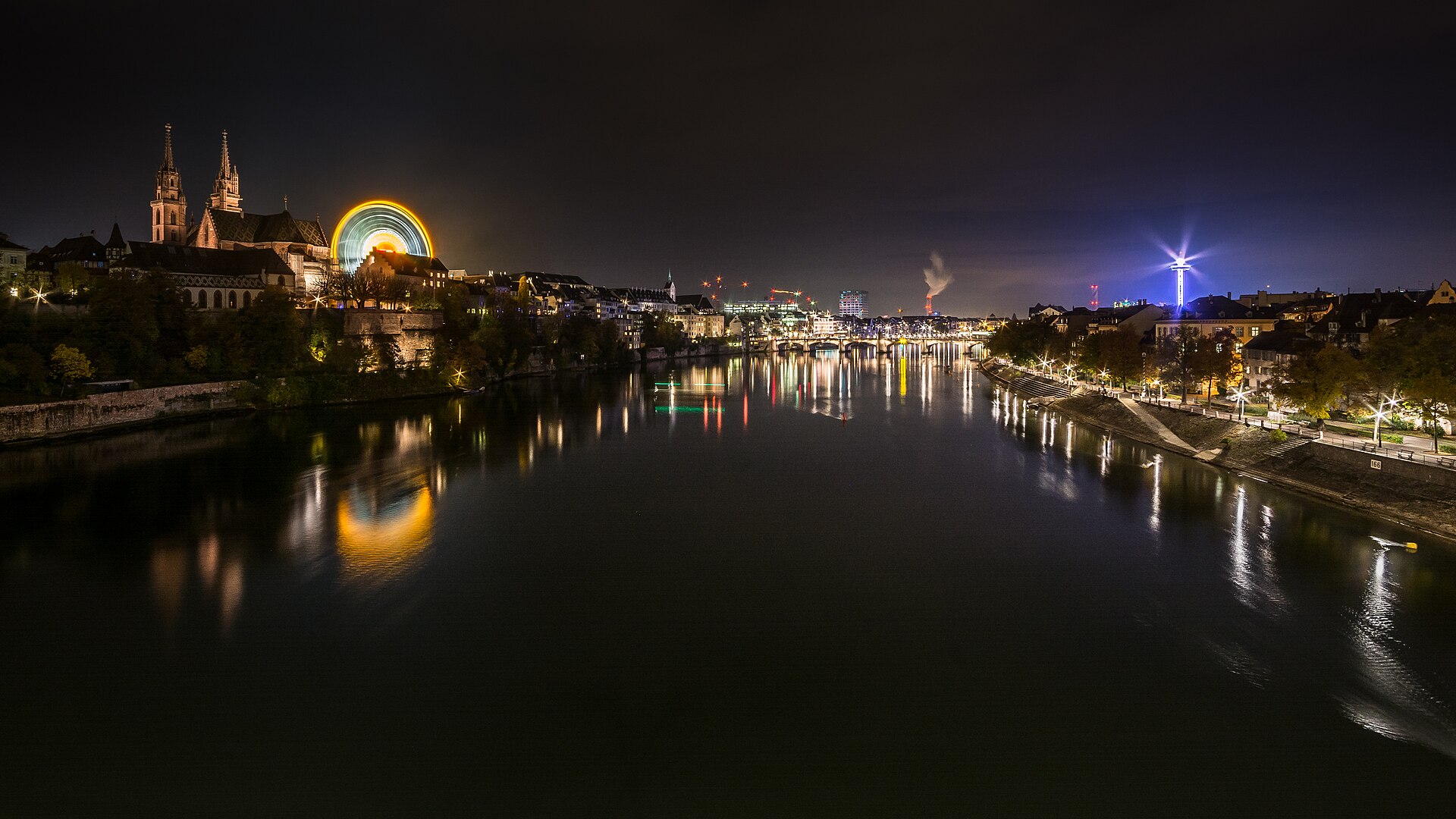
The fair city, with a public collection that predates most national museums. Kunstmuseum, Kunsthalle and Museum Tinguely are a walk or a tram apart.
Photo: Kuhnmi, Wikimedia Commons, CC BY-SA 4.0.
Biennale / Country hubs / Switzerland
Country hubs · Free to read · Updated October 5, 2026
Country hub · Europe
A small market with the largest fair in the trade, where museum budgets go to a public vote and the provenance of a collection is argued in court.
Autumn 2026
Swiss art had two results in one weekend. On Saturday, September 26, the Fondation Beyeler opened Peter Zumthor’s extension in Riehen, a SFr120 million project paid for largely by one donor, as The Art Newspaper reported. On Sunday, Zurich voters agreed to give the Kunsthaus another CHF 7.3 million a year, by 55.4% to 44.6%, according to the count carried by Radio Central. One museum grew on private money. The other needed a ballot.
That pairing is the argument of this page. Switzerland is a small art market that carries large infrastructure: the leading fair in the trade, a set of museums larger than its cities would suggest, bonded warehouses, and private collections that rank with national ones elsewhere. For decades the country could run all of it quietly. In 2026 each part is being asked, in public, who pays and who answers for it.
The fair is the healthy part. Art Basel drew 290 galleries and 90,000 visitors in June, and its parent, MCH Group, returned to a solid profit. The museums are the exposed part. The Kunsthaus runs a structural deficit while its best-known loan, the Bührle Collection, is the subject of a court case between the lender and the city. And since March 1 a federal commission chaired by a former president has been open to claims over Nazi-era and colonial-era holdings.
None of this makes Switzerland less worth the trip. It makes it more legible. The visitor who takes the tram from Basel’s fair halls to Riehen, or the train to Zurich, is walking through a system that has started explaining itself.
The market
The Art Basel and UBS Art Market Report 2026 puts global sales in 2025 at $59.6 billion, up 4%. Swiss sales rose 13%, three times the global rate, while Germany fell 10% and Italy 2%, by the report’s figures as summarized by Artlyst. The Swiss news agency account carried by Bluewin still calls the national market “rather small”. The report’s published summaries give no dollar value or global share for Switzerland, and none is offered here.
Art Basel ran June 18 to 21 with 290 galleries from 43 countries, 90,000 visitors and representatives of more than 270 museums and foundations, according to the fair’s closing report. The top reported sales were a 1963 Picasso at $35 million and a Gerhard Richter at $20 million. The 2027 edition is set for June 17 to 20.
The fair belongs to MCH Group, a listed Basel company. In 2025 it reported operating income of CHF 429.6 million and net profit of CHF 18.6 million, up from CHF 3 million, and called Art Basel its strongest earnings pillar, per the results release. Its shareholder register shows who decides: Lupa Investment Holdings, the vehicle through which James Murdoch bought into the company, held 41.94% at the end of 2025, and the Canton of Basel-Stadt 37.52%. A New York investor and a Swiss canton own the trade’s main marketplace between them.
Swiss regulation of the trade is lighter than its reputation suggests and heavier than it was. Art dealers are generally not treated as financial intermediaries under the Anti-Money Laundering Act; the main duty that reaches them is due diligence on cash payments above CHF 100,000, according to a comparative study in the Harvard International Law Journal, which notes that a 2022 parliamentary motion to bring dealers fully under the act was still in committee in late 2024. The Geneva Freeport, majority-owned by the canton, has had to record owners in its inventories since 2016. The often-quoted estimate of about 1.2 million works stored there dates from 2013, as Wikipedia’s summary of the sources makes clear. Dated figure
The law that governs what crosses the border is the Cultural Property Transfer Act, in force since June 1, 2005. It regulates the import, transit, export, and return of cultural property, carries the 1970 UNESCO Convention into Swiss law, and puts special due-diligence duties on dealers and auction houses, as the Federal Office of Culture sets out. The act is used. Switzerland handed 48 artifacts to Italy on June 19, 2025, by the office’s 2025 notices, and a notice of September 15, 2026 records the return of a second-century BC mask to Egypt.
“After more than 25 years of debate and delay, we have moved beyond words and into action.”
— Andrea Raschèr, consultant and former Swiss culture ministry official, on the new federal commission, to The Art Newspaper, January 30, 2026Politics and money
Culture in Switzerland is first a matter for cantons and cities. The federal layer is thin and specific. Parliament’s four-year Culture Dispatch for 2025 to 2028 is worth CHF 988 million, of which CHF 187 million goes to the arts council, Pro Helvetia, about CHF 210 million to film and CHF 139 million to the Swiss National Museum, according to Swissinfo. The umbrella body Suisseculture called the package, trimmed by CHF 14 million from earlier plans, a blow to the sector. The minister responsible, Elisabeth Baume-Schneider, presented it as a shift toward fair pay and social security for artists.
Pro Helvetia has had its own brush with parliament. In 2024 the lower house voted to cut CHF 6.5 million from its budget over what members called problematic activity in Russia. The Senate restored the money that September and the council closed its Moscow office, Swissinfo reported. The council has had a new director, Michael Kinzer, since July 2025. It also runs the Swiss Pavilion in Venice, and for 2026 it chose the project by open competition for the first time, from 140 submissions and with a project budget of CHF 250,000, as ArtDependence noted.
The Kunsthaus Zürich has drawn more than 500,000 visitors a year since its David Chipperfield extension opened in 2021, about 100,000 more than planned, and still cannot cover its costs, by the museum’s own account. The city parliament backed a higher subsidy by 100 votes to 16. The Swiss People’s Party campaigned against, arguing for more thrift and against favoring large institutions. Voters approved the increase on September 27, taking the city’s contribution to CHF 25.8 million a year until 2033.
The campaign, as the Zurich outlet Tsri summarized it, turned on faulty financial planning for the Chipperfield extension, on the handling of the Bührle Collection, and on a complaint that city money favors large houses while small ones fight for every franc. The higher subsidy starts in 2028.
The harder question hangs in the new wing. The Bührle Collection, 205 works assembled by the arms manufacturer Emil Bührle, is on long loan from a private foundation. After a 2024 review by the historian Raphael Gross found the foundation’s provenance research inadequate, five paintings came off the walls, and settlements followed with heirs over a Manet and a Gauguin, the Kunsthaus records. In February 2026 Zurich funded a five-year research project overseen by three independent experts. The city parliament approved the money on February 4 by 104 votes to 13. Supporters, the Green Liberals among them, argued that only deeper research can show whether the collection holds looted or flight assets. Stefan Urech of the Swiss People’s Party called the effort left-wing harassment of the foundation, and Yasmine Bourgeois of the Liberals (FDP) warned that mistrust could become a loop without end, according to the agency report carried by Swissinfo.
The foundation has since removed Zurich from its statutes, which means the pictures need not stay. The city has gone to the administrative court to contest the change, citing its investment in the building. A foundation board member, Victor Schmid, told Swiss public broadcaster SRF that the paintings belong to the foundation alone and that he was surprised by the city’s idea of cooperation. The loan agreement runs to 2034.
Three months before Zurich said yes, the canton of Bern said no. On June 14, 2026, voters rejected the financing for the Kunstmuseum Bern’s CHF 147 million renewal by 51.8%, after a cross-party group that wanted a more modest project gathered 10,000 signatures to force a referendum, Swissinfo reported. The director, Nina Zimmer, in post since 2016, said the museum had hoped for a different result and respected the decision. She had announced in March that she is leaving to direct the Belvedere in Vienna. The museum inherited about 1,600 works from Cornelius Gurlitt in 2014 and set up the country’s first dedicated provenance research department.
The Commission for Historically Problematic Cultural Heritage began work on March 1 under Simonetta Sommaruga, twice president of the Confederation. It has 10 members, covers Nazi-era and colonial contexts, and issues recommendations that do not bind. Its sharpest tool is narrow: for suspected Nazi loot in publicly funded museums, a claimant can bring a case without the museum’s consent, The Art Newspaper reported. Supporters see a debt to history being paid. Skeptics will note that a private lender, such as a foundation, sits outside that rule.
Colonial collections are moving on a separate track. Nine museums will study more than 6,300 objects from Cameroon with SFr100,000 from the Federal Office of Culture, a sum that Legrand Tchatchouang, a civil-society member of Cameroon’s repatriation committee, set against the risk of what he called a Eurocentric project, in the same paper’s report of October 2.
The city of Zurich has already acted on its own holdings. In March 2026, as owner of the Museum Rietberg, it transferred title to 11 Benin objects to Nigeria’s National Commission for Museums and Monuments, The Art Newspaper reported. Two of them, a commemorative head and an ivory tusk, were to travel to Nigeria; nine stay in Zurich as loans. The Benin Initiative Switzerland, launched in 2021, has identified 55 objects in Swiss museums that were probably taken in the looting of 1897.
“The Nigerian side was very interested in the idea that the history and the artistry of Benin would still be told in Switzerland.”
— Annette Bhagwati, director of the Museum Rietberg, to The Art Newspaper, March 20, 2026
Society
Swiss museums recorded almost 15 million admissions in 2023, 5% above the last year before the pandemic, according to the Federal Statistical Office. For a country of about nine million people that is a habit, and it explains why a museum subsidy can win a city-wide vote.
The private side is just as Swiss. The Fondation Beyeler, founded on a dealer’s collection, has added a gallery building, a pavilion for events and an office gatehouse to Renzo Piano’s museum. The philanthropist Hansjörg Wyss paid for most of the main building, which adds 1,500 square meters of exhibition space to Piano’s 3,800. The opening display, Constellations, runs to September 5, 2027, with reduced opening days until mid-January while the staff learns the new site.
“I like museums that only serve art.”
— Peter Zumthor, architect of the Fondation Beyeler extension, to The Art Newspaper, September 25, 2026
The pattern repeats down the Rhine and along the lakes. The Migros Museum carries a retailer’s name, and Zurich’s Löwenbräu complex puts private foundations, commercial galleries and a public Kunsthalle under one roof. Public and private rooms sit a tram stop apart and the visitor rarely needs to know which is which. The Bührle case is the reminder that the difference matters when a loan is questioned.
Switzerland’s entry at the Venice Biennale this year takes the national habit of consensus as its subject. The Unfinished Business of Living Together returns to Swiss television broadcasts of 1978 and 1984 that put homosexuality up for public debate. Its curator, Gianmaria Andreetta, told The Art Newspaper France that the idea is to look at how a society stages coexistence, tolerance, and agreement. The pavilion opened into a tense edition: the jury resigned on April 30 over the participation of Russia and Israel, and the prizes were moved to a visitor vote, the same paper reported.
The cities
The Swiss art cities are a few hours apart by rail at most, and the density is the point. Directory pages are linked where My Biennale has them.
Northwest · Rhine
The fair city, with a public collection that predates most national museums. Kunstmuseum, Kunsthalle and Museum Tinguely are a walk or a tram apart.
Photo: Kuhnmi, Wikimedia Commons, CC BY-SA 4.0.
Basel-Stadt · Tram 6
A village on the German border with one reason to go, now enlarged: the Fondation Beyeler and its new Zumthor buildings.
Canton of Zurich
A short train ride from Zurich and home to the Fotomuseum. One of the cities whose museums are in the Cameroon provenance study.
The Alps
Winter brings dealers to the resorts. The Art Newspaper covered a Picasso show in Gstaad and 10 works to see in Graubünden during Davos week. No directory pages yet.
Biennales and fairs
Switzerland has one event the whole trade attends and several that reward a quieter visit. It has no recurring art biennale of its own; the one time the roving European biennale came, it was Manifesta 11 in Zurich in 2016.
| Event | City | Next or most recent | What it is | Directory |
|---|---|---|---|---|
| Art Basel | Basel | June 17–20, 2027 (previews June 15–16). Last: June 18–21, 2026 | The trade’s leading fair; 290 galleries in 2026 | 2027 page · 2026 page |
| Art Genève | Geneva | January 28–31, 2027, Palexpo, per the fair | Modern and contemporary fair, more than 80 galleries | Not yet listed |
| Zurich Art Weekend | Zurich | Ninth edition June 12–14, 2026, per the organizers. 2027 not yet announced | City-wide openings at 70-plus venues, the weekend before Art Basel | Not yet listed |
| Liste Art Fair Basel | Basel | June 14–20, 2027, Hall 1.1 of Messe Basel, per the fair | The young-gallery fair that runs alongside Art Basel | Not yet listed |
| Design Biennale Zurich | Zurich | Most recent edition 2025. Next not yet announced | Design biennale | Series page |
| Manifesta | Zurich (2016) | Manifesta 11 was held in Zurich in 2016; the 2028 edition goes to Coimbra, Portugal | The roving European biennale | Series page |
Dates as listed by each museum in October 2026.
Museums and players
Going there
June is the obvious month and the expensive one. Zurich Art Weekend has run the weekend before Art Basel, so a traveler can do both cities in six days, starting on the Limmat and finishing on the Rhine. Basel hotels sell out for fair week many months ahead; rooms across the borders in Germany and France are the usual fallback. Start with the Basel and Zurich pages, then build an itinerary at My Biennale trips.
The better-kept season is now. The Beyeler’s opening display is up through next summer, on a reduced five-day week until January 14, 2027, so check the days before taking the tram. Art Genève at the end of January gives a reason to see Geneva in winter. Rail does the rest: the cities on this page are all linked by direct trains. For tickets and museum passes, see My Biennale tickets.
For the wider circuit, Biennales in Europe sets Switzerland against its neighbors, and Art in Italy covers the Swiss Pavilion’s host. Biennale Traveller has the practical pieces on flights, beds and pacing. This page, like the rest of the site, is free to read.
2027
Sources. Art Basel and UBS Art Market Report 2026; Art Basel; MCH Group; MCH Group 2025 results; Kunsthaus Zürich on the vote and on the Bührle Collection; City of Zurich; Radio Central; SRF; Swissinfo; Federal Statistical Office; The Art Newspaper on the commission, the Beyeler and the Cameroon study; Harvard International Law Journal; Wikipedia on Manifesta; Federal Office of Culture on the transfer of cultural property, 2025 notices and 2026 notices; Tsri; Swissinfo on the Zurich parliament and the Kunstmuseum Bern; The Art Newspaper on the Museum Rietberg; The Art Newspaper France on the Swiss Pavilion and the Venice jury; Liste Art Fair Basel; Art Basel Qatar; Fondation Beyeler; Kunstmuseum Basel; Kunsthaus Zürich program; Kunstmuseum Bern. Directory listings from My Biennale. Not found and so left out: a current value or global share for the Swiss market, and 2026 figures for freeport holdings. Corrections: contact@biennale.nyc.